About
The Old Royal Naval College is the monumental Baroque riverside complex designed principally by Sir Christopher Wren, standing on the site of the former Tudor Greenwich Palace and forming, together with the Royal Observatory, Queen's House and Greenwich Park, the core of the Maritime Greenwich UNESCO World Heritage Site.
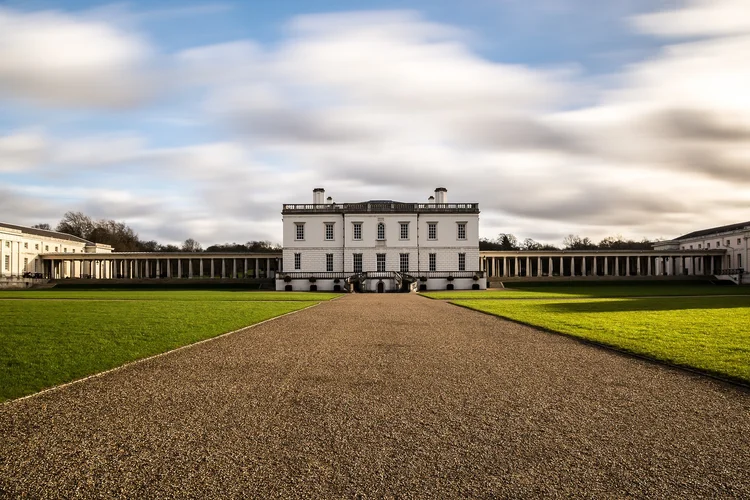
Built from 1696 as the Royal Hospital for Seamen, a charitable institution providing care for injured and retired sailors of the Royal Navy, the complex's paired domed buildings and grand colonnades were designed to frame views of the Queen's House and the river beyond, one of the most celebrated pieces of urban planning in English architectural history and a design deliberately intended to rival the great continental palaces of the period.
The hospital closed in 1869, and from 1873 until 1998 the buildings served as the Royal Naval College, training generations of naval officers, before passing into the care of the Greenwich Foundation, a charitable trust established to conserve the buildings and open them to the public and to the University of Greenwich and Trinity Laban Conservatoire, who now occupy much of the site for teaching.
The complex's outstanding artistic treasure is the Painted Hall, decorated by Sir James Thornhill between 1707 and 1726 with an immense allegorical ceiling and wall painting celebrating British naval power, monarchy and the triumph of liberty over tyranny, a scheme so ambitious in scale and ambition it is often described as Britain's Sistine Chapel and which, in 2026, marks the three-hundredth anniversary of its completion.
Adjacent to the Painted Hall, the Chapel of St Peter and St Paul, rebuilt in a lighter neoclassical style following a fire in 1779, provides a contrasting devotional space still used for services and events. Visitors today can explore the Painted Hall and Chapel, take guided or self-guided tours through the Visitor Centre's interpretation of the site's naval, architectural and social history, and walk freely through the extensive riverside grounds, which remain open to the public throughout the day and have featured in numerous film productions thanks to their grandeur and river setting.
Categories:
Plan Your Visit
⏱️ Recommended Visit Duration
📅 Best Times to Visit
Quietest: Monday, Tuesday
Busiest: Saturday, Sunday
💡 Weekday mornings for the quietest visit to the Painted Hall.
💡 Visitor Tips
- General admission includes the Painted Hall, Chapel, Visitor Centre and daily expert-led talks - factor in time for a talk if you can.
- The ticket converts to a free annual pass, worth using if you plan to revisit Greenwich within the year.
- The wider grounds are free to enter and open long hours daily, making them worth exploring even without paying for the Painted Hall.
- 2026 marks the 300th anniversary of the Painted Hall's completion - check for special anniversary events and displays.
- Combine your visit with the nearby National Maritime Museum, Queen's House and Royal Observatory for a full Maritime Greenwich day.
- Arrive on weekday mornings for the quietest experience of the Painted Hall, which can get busy with tour groups later in the day.
- Photography is permitted but flash and tripods are restricted to protect the historic ceiling painting.
- Cutty Sark DLR station is the closest stop, just a few minutes' walk away.
Highlights
The Painted Hall
Sir James Thornhill's ceiling and wall paintings, executed between 1707 and 1726 across nearly 40,000 square feet of surface, form one of the most spectacular Baroque decorative schemes in Britain, celebrating naval power, the reigning monarchy and the triumph of liberty and peace through an elaborate allegorical programme populated by classical gods, personifications and portraits of contemporary figures.
Often described as Britain's Sistine Chapel for its ambition and scale, the Hall was originally intended as a dining room for injured and retired seamen but proved so magnificent it was used only for ceremonial occasions, including lying in state for Lord Nelson in 1806. In 2026 the Hall celebrates the 300th anniversary of its completion, and recent conservation work has revealed the painting's original vivid colours after removing centuries of accumulated grime and varnish.
The Undercroft and Visitor Centre
Beneath the Painted Hall, an atmospheric undercroft space has been converted into a modern Visitor Centre exploring the site's full history from Tudor royal palace through naval hospital, officer training college, and its present role under the Greenwich Foundation, using interactive displays, archaeological finds and multimedia interpretation.
The centre provides essential context before or after visiting the grander state spaces above, helping visitors understand the layered history beneath Wren's celebrated Baroque exterior.
The Chapel of St Peter and St Paul
Rebuilt in an elegant, restrained neoclassical style following a serious fire in 1779, the Chapel provides a striking contrast to the exuberant Painted Hall, its pale interior, fine plasterwork and altarpiece by Benjamin West reflecting late eighteenth-century taste for classical restraint over Baroque theatricality.
Still used for services, concerts and events, the Chapel remains a living part of the complex rather than a purely historic display space, continuing traditions of worship established when the buildings served as a naval hospital.
Christopher Wren's Baroque Masterplan
The complex's overall design, developed principally by Sir Christopher Wren with contributions from Nicholas Hawksmoor and John Vanbrugh, is celebrated as one of the outstanding achievements of English Baroque urban planning, its paired domed buildings deliberately arranged to preserve river views from the Queen's House behind while creating a monumental ceremonial approach from the Thames.
This design solution, balancing royal sightlines against the need for a grand naval institution, is widely studied as a masterclass in large-scale architectural composition.
Collections
The Old Royal Naval College's principal 'collection' is architectural and artistic: Christopher Wren's Baroque building complex, Sir James Thornhill's Painted Hall ceiling and wall paintings, and Benjamin West's Chapel altarpiece, together with archaeological finds relating to the earlier Tudor Greenwich Palace that once stood on the site.
The Visitor Centre's interpretive displays draw on naval, architectural and institutional archives documenting the site's successive uses as the Royal Hospital for Seamen and later the Royal Naval College, connecting the building's outstanding artistic and architectural significance to the social history of the sailors and officers who lived, worked and trained here across more than three centuries.
The Painted Hall
Sir James Thornhill's monumental Baroque ceiling and wall paintings, celebrating naval power and completed in 1726.
📍 King William Building
Under the Painted Hall: Visitor Centre
Interactive displays exploring the site's history from Tudor palace through naval hospital and officer training college.
📍 Undercroft
Themes
Time Periods
Current Exhibitions
No current exhibitions. Please check the museum website for updates.