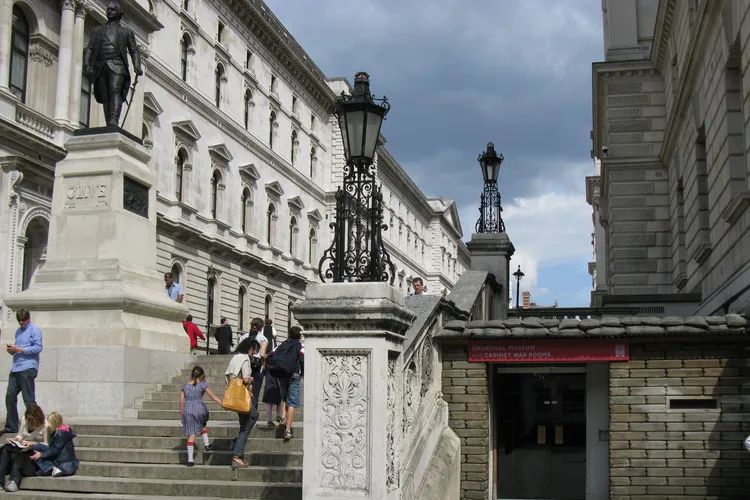
Photo: IxK85 / CC BY-SA 3.0 — cropped and resized
About
Churchill War Rooms offers a fascinating and atmospheric journey into the secret underground headquarters where Winston Churchill and his wartime government directed Britain's war effort during the Second World War. Hidden beneath the streets of Westminster, this labyrinth of rooms served as the nerve center of Britain's war machine from 1939 to 1945.
The Cabinet War Rooms have been preserved exactly as they were left on the day the lights were switched off in August 1945 - maps still pinned to walls, furniture in place, telephones ready to ring.
Walk through the cramped corridors and spartan rooms where Churchill made speeches, held War Cabinet meetings, and plotted strategy with military leaders and advisors. See the Map Room, operational 24 hours a day throughout the war, with its original maps tracking Allied and enemy positions. Stand in the Cabinet Room where Churchill and his War Cabinet took the crucial decisions that shaped the course of WWII.
Visit Churchill's bedroom, the Transatlantic Telephone Room (disguised as a toilet) where he spoke to President Roosevelt, and the typing pool where young women worked around the clock in windowless rooms. The award-winning Churchill Museum, opened in 2005, explores every aspect of Churchill's extraordinary life through interactive displays, personal letters, iconic possessions, and rare artifacts.
From his aristocratic Victorian childhood through his wilderness years to his finest hour as wartime leader, the museum reveals the man behind the myth.
This is history brought to life - an authentic wartime time capsule combined with a biographical journey through one of the 20th century's most significant figures.
Categories:
Annual Visitors (2019)
400,000
Plan Your Visit
⏱️ Recommended Visit Duration
📅 Best Times to Visit
Quietest: Tuesday, Wednesday, Thursday
Busiest: Saturday, Sunday
💡 First entry slot (09:30) or weekday afternoons. Underground location means weather doesn't matter.
💡 Visitor Tips
- Book online in advance for 10% discount and guaranteed entry - the museum sells out
- First entry slot (09:30) is quietest - book early for best experience
- The multimedia guide is essential and included - use it in every room for Churchill's voice and context
- Allow 2 hours minimum - 90 minutes for War Rooms, 45-60 minutes for Churchill Museum
- Personal photography is allowed (no flash) - great for memories
- The underground bunker is surprisingly small and basic - this ordinariness makes the history more powerful
- Wear layers - the underground temperature is constant year-round (cool)
- Visit in combination with Parliament, Westminster Abbey, and Downing Street for a 'Power of Westminster' day
- The Churchill Museum at the end is comprehensive - don't rush it
- The exit through the shop is one-way - you can't return to the War Rooms
Highlights
The Cabinet Room
The heart of Britain's wartime government, where Winston Churchill presided over more than 100 Cabinet meetings throughout WWII. The room is preserved exactly as it was on August 16, 1945, the last day it was used. Churchill's chair sits at the head of the table, marked with a small tag bearing his name.
The room is surprisingly small and basic - brown-painted walls, a low ceiling, simple wooden furniture. Maps hang on the walls, a baize-covered table dominates the space, ashtrays and microphones sit ready. This is where momentous decisions were made: the evacuation of Dunkirk, the Battle of Britain strategy, D-Day planning.
The atmosphere is extraordinarily powerful - you can almost hear Churchill's growl and smell the cigar smoke. The room's very ordinariness makes the history more tangible.
The Map Room
The operational heart of the War Rooms, staffed 24 hours a day from its opening in 1939 until victory in 1945. The room coordinated intelligence from across the globe, tracking the positions of Allied and enemy forces on maps that still hang on the walls with their original pin marks. Colored telephones connected to military commands worldwide.
The room's most poignant feature is the clocks showing different time zones - London, Washington, Moscow. Everything remains as it was when the lights went out in August 1945, creating a frozen moment in time. The Map Room was the only part of the War Rooms that never closed during the entire war.
Churchill's Bedroom
A spartan, windowless room where Churchill occasionally slept during air raids, though he preferred 10 Downing Street when possible. The narrow bed, simple desk, and chamber pot reveal the basic conditions even the Prime Minister endured underground. This room humanizes Churchill - the great war leader reduced to sleeping in a converted broom cupboard.
The multimedia guide includes Churchill's own descriptions of life underground and his battles with depression ('the black dog') during the darkest days of war. The bedroom's intimacy contrasts powerfully with Churchill's larger-than-life public image.
The Transatlantic Telephone Room
One of the most fascinating spaces in the War Rooms - a converted broom cupboard disguised as Churchill's private toilet, actually housing the 'Sigsaly' scrambler telephone that allowed secure communication with President Roosevelt in Washington. The room was called 'the Scrambler' by staff, and only Churchill and a handful of senior officials knew its true purpose.
The sophisticated encryption technology (designed by Bell Labs) was so secret that the room's existence wasn't revealed until the 1970s.
Churchill's conversations with Roosevelt from this tiny room helped forge the Anglo-American alliance that won the war. The juxtaposition of world-changing conversations in a toilet-sized space is quintessentially British.
Collections
Churchill War Rooms comprises two main elements: the Cabinet War Rooms (the original underground bunker preserved as it was in 1945) and the Churchill Museum (opened 2005). The Cabinet War Rooms include 21 historic rooms arranged along underground corridors - the Cabinet Room, Map Room, Churchill's bedroom and office, the Transatlantic Telephone Room, typing pools, sleeping quarters for staff, and the BBC broadcast room.
Everything is authentic - original furniture, maps with pin marks, telephones, and personal items left when the lights went off in August 1945.
The Churchill Museum holds the world's most comprehensive collection relating to Churchill's life: over 1,000 artifacts including personal letters, speeches, paintings, clothing, medals, books, photographs, and memorabilia spanning his 90-year life from 1874 to 1965. The interactive Lifeline lets visitors explore any day of Churchill's life.
The museum doesn't just celebrate Churchill - it critically examines his complex legacy, mistakes, and controversial views.
Cabinet War Rooms
Original WWII underground bunker preserved exactly as it was in 1945, including Cabinet Room, Map Room, Churchill's bedroom, and staff areas
📍 Underground bunker
Churchill Museum
Comprehensive interactive biography of Winston Churchill from birth to death, with over 1,000 artifacts and the unique Lifeline interactive table
📍 Underground museum space
Themes
Time Periods
Current Exhibitions
No current exhibitions. Please check the museum website for updates.