The City of 126 Churches: Medieval London's Lost Religious Landscape
Medieval London was quite possibly the most church-dense city in Christendom. And while that might sound like dry ecclesiastical statistics, the reality is far more fascinating—because those churches weren't just places of worship. They were the community centres, the social clubs, the birth registries and death registries, the news networks and gossip exchanges, the charity offices and welfare systems of their age. They defined neighbourhoods, marked boundaries, and gave ordinary Londoners their primary identity beyond family and trade.
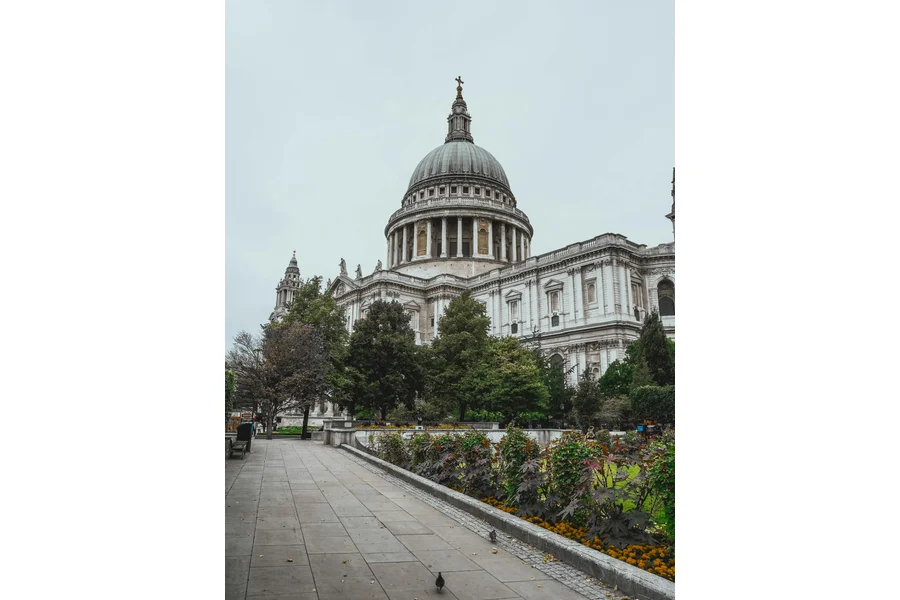
Most of them are gone now. Some were destroyed in the Great Fire of 1666. Others fell to Victorian "improvement." A handful were bombed in the Blitz. But their ghosts linger in street names, parish boundaries, and the handful of extraordinary survivors that still stand amid the glass and steel of the modern City.
This is the story of London's lost religious landscape—and why it matters.
Why So Many Churches?
The first question any modern visitor asks is: why on earth did medieval London need 126 parish churches? The population within the walls, even at its medieval peak, was probably no more than 40,000 to 50,000 people. That works out to roughly one church for every 300-400 residents—a ratio that seems absurdly high by today's standards.
The answer lies in how medieval parishes developed. Unlike modern churches, which are built where planners decide they're needed, medieval parish churches grew organically from the bottom up. A wealthy merchant might build a small chapel for his household and neighbours. A guild might establish a church for its members. A landowner might provide a place of worship for his tenants. Over time, each of these private or semi-private chapels would acquire parish rights—the authority to baptise, marry, and bury—and become the centre of a tiny parish that might cover just a few streets, or even a single street.
The result was parishes of wildly varying sizes. Some London parishes were prosperous and populous, covering substantial areas. Others were minuscule. The parish of St. Margaret Moses, for instance, covered just a handful of houses on Friday Street. St. Mildred Poultry served an area so small that its congregation could practically wave to each other from their front doors.
This wasn't inefficiency—it was community. Your parish church wasn't just where you went to hear mass. It was where your name was recorded at birth, where you were confirmed, where you were married, where your children were baptised, where you confessed your sins, where you received communion, and where you would eventually be buried. The parish priest knew every soul in his care personally. The churchwardens knew who was sick, who was poor, who had just had a baby, who had just lost a husband. In an age before social services, before NHS, before any kind of welfare state, the parish was the safety net.
What the Names Tell Us
Even where the churches have vanished, their names survive—and those names are a window into medieval London life.
Take St. Botolph. There were four churches dedicated to this saint in medieval London: St. Botolph Aldgate, St. Botolph Aldersgate, St. Botolph Bishopsgate, and St. Botolph Billingsgate. Notice the pattern? Every one of them stood at or near a gate. That's because St. Botolph was the patron saint of travellers. If you were leaving London through one of the great gates in the wall, or arriving after a long journey, St. Botolph's was where you stopped to pray for a safe journey or give thanks for safe arrival. Three of these churches still exist—remarkable survivors that still welcome travellers today.
St. Olave appears three times in medieval London records. This is a Danish saint—King Olaf II of Norway, who helped Ethelred the Unready attack the Danes occupying London in 1014 by pulling down London Bridge. The presence of churches dedicated to a Scandinavian saint tells us about the Danish community that lived in London after the Viking era, and their integration into the city's religious life.
St. Andrew Undershaft has one of the most charming name origins. This church on Leadenhall Street still stands, and its peculiar surname comes from a maypole that used to be set up beside it each spring. The maypole was so tall that it overtopped the church steeple—hence "Undershaft," meaning the church that stood under the shaft. The maypole was eventually taken down in 1517 after a riot, but the name endured.
St. Mary Woolchurch and St. Mary Woolnoth both commemorate the wool trade that made medieval London rich. St. Nicholas Cole Abbey and St. Nicholas Shambles honoured the patron saint of children and sailors—the original Santa Claus. St. Dunstan in the East and St. Dunstan in the West were named for the great Anglo-Saxon saint who was Archbishop of Canterbury and a renowned metalworker.
And then there are the dedication puzzles. Why were so many churches dedicated to All Hallows (All Saints)? Why so many to the Virgin Mary under various titles—St. Mary le Bow, St. Mary Aldermary, St. Mary Somerset, St. Mary Abchurch, St. Mary at Hill? The Virgin was by far the most popular dedication in medieval Christendom, but London seems to have been especially devoted to her.
Churches on Roman Foundations
One of the most intriguing aspects of London's medieval churches is how many of them seem to stand on sites that were sacred in Roman times. The evidence is fragmentary but suggestive.
St. Peter upon Cornhill claims to be the oldest church in London, supposedly founded in AD 179 by King Lucius—a legendary figure whose existence is doubtful, but the tradition itself is ancient and interesting. The church stands on one of the two hills that defined Roman London (the other being Ludgate Hill, where St. Paul's stands). Archaeological excavations have found Roman remains beneath the church, and the dedication to St. Peter—the rock on which Christ built his church—suggests an early and important foundation.
St. Paul's Cathedral stands on Ludgate Hill, the highest point in the Roman city. While there's no definitive proof that a Roman temple stood here, the location would have been perfect for one. Roman cities typically placed their most important temples on high ground, and Christian missionaries often built churches on former pagan sacred sites—a practice of deliberate replacement that sent a clear message about the triumph of the new faith.
Several churches along Thames Street—St. James Garlickhythe, St. Michael Queenhithe, and others—may preserve the locations of Roman waterfront shrines. Roman merchants and sailors were notably superstitious, making offerings to various deities before and after voyages. When Christianity came, these riverside sacred spots would have been natural locations for churches serving the maritime community.
The Great Conventual Churches
Beyond the 126 parish churches, medieval London boasted thirteen great conventual churches—the churches of monasteries, priories, and friaries that ringed the City and spread into its suburbs.
These were not parish churches. Ordinary Londoners couldn't be baptised, married, or buried there (with some exceptions). But they could and did attend services, especially the elaborate musical liturgies for which the monastic churches were famous. They could also benefit from the charitable works that monasteries performed—hospitals, almshouses, schools, and the daily distribution of alms to the poor.
St. Bartholomew the Great in Smithfield, founded in 1123 by Rahere, a courtier who fell ill on pilgrimage to Rome and vowed to build a hospital and priory if he recovered. It's the oldest surviving church building in London, and walking through its great Norman arches today is as close as you can get to experiencing medieval London's sacred architecture.
St. Helen's Bishopsgate was a Benedictine nunnery founded before 1210. Parts of it survive incorporated into the current church, including the nuns' choir—a rare example of a double church where nuns and parishioners worshipped simultaneously but separately.
The Temple Church, built by the Knights Templar in the 1160s, is one of only four round churches surviving in England. Its design was based on the Church of the Holy Sepulchre in Jerusalem, which the Templars were sworn to protect. After the suppression of the Templars in 1312, it passed to the Knights Hospitaller and eventually became the church of the legal profession—as it remains today.
Greyfriars (the Franciscans) and Blackfriars (the Dominicans) established large priories in London in the thirteenth century. The Greyfriars church was so magnificent that several medieval queens were buried there. Both were destroyed at the Dissolution of the Monasteries under Henry VIII, though Blackfriars gave its name to a district that persists today.
Charterhouse, the Carthusian monastery north of Smithfield, was founded in 1371 on a site used as a mass burial ground during the Black Death. The Carthusians were the strictest of the monastic orders, living in individual cells and maintaining almost perpetual silence. Charterhouse survived the Dissolution (barely—several of its monks were executed for refusing to accept Henry VIII's supremacy) and was refounded as a school and almshouse. The buildings still stand and can be visited.
Inside a Medieval Parish Church
What would it have been like to step inside one of those 126 parish churches? Nothing like stepping into a church today.
First, forget the pews. Medieval churches didn't have them. The congregation stood—or knelt, or prostrated themselves—on a floor of beaten earth or stone flags. There might be a stone bench running along the walls for the elderly and infirm (hence the saying "the weakest go to the wall"), but most worshippers stood throughout services that could last for hours.
Second, forget the clear glass and the whitewashed walls. Medieval churches blazed with colour. Every surface that could be painted was painted—walls covered with scenes from the Bible and the lives of saints, columns decorated with geometric patterns, the ceiling often painted blue and studded with gold stars to represent heaven. Windows glowed with stained glass depicting Christ, the Virgin, the apostles, the patron saint of the parish. Even the floor might be decorated with coloured tiles.
Third, forget being able to see the altar. The nave (where the congregation stood) was separated from the chancel (where the priest celebrated mass) by the rood screen—a wooden partition topped by a great crucifix (the "rood"). The screen might have openings through which you could glimpse the altar, but the whole point was that the sacred mysteries of the mass were partially hidden from view. When the priest elevated the consecrated bread, a bell would ring so the congregation knew to look up and see the host raised above the rood screen.
The church would have been lit by candles—hundreds of them on major feast days, creating a flickering, mysterious atmosphere quite unlike modern electric lighting. The smell would have been a mixture of incense, candle wax, and humanity (remember, this was an age before deodorant, and medieval Londoners bathed infrequently). The sound would have been Latin chanting, bells, and the murmured prayers of the congregation.
And everywhere, reminders of death. Medieval churches were not just places of worship but places of burial. The wealthy were buried inside the church itself, their tombs and memorial brasses covering the floor and lining the walls. The less wealthy were buried in the churchyard outside. But either way, you literally walked over the dead when you entered church—a constant reminder of mortality and the life to come.
St. Mary le Bow and the Bow Bells
If you've heard the phrase "born within the sound of Bow Bells," you know that St. Mary le Bow holds a special place in London identity. According to tradition, only those born close enough to hear the bells of this church—in Cheapside, at the very heart of the City—can claim to be true Cockneys.
But Bow Bells were famous long before they defined Cockney identity. In medieval London, the great bell of St. Mary le Bow rang the curfew—the signal for citizens to extinguish their fires, close their shops, and prepare for bed. In an age before street lighting, when fire was a constant danger and footpads lurked in dark alleys, the curfew wasn't oppressive—it was sensible.
The church gets its distinctive name from the "bows" or arches of its Norman crypt, which survive beneath Christopher Wren's post-Fire rebuilding. This crypt is one of the finest examples of Norman ecclesiastical architecture in London, and you can visit it today—a journey back nearly a thousand years, right in the middle of the modern City.
St. Mary le Bow was also the church where the Court of Arches sat—the chief ecclesiastical court of the Province of Canterbury, which heard appeals from church courts throughout southern England. The name "Court of Arches" comes from those same Norman bows or arches. This made St. Mary le Bow one of the most legally significant churches in England, a centre of ecclesiastical power second only to Canterbury itself.
The church was completely destroyed in the Great Fire of 1666 and rebuilt by Wren with one of his most elegant steeples. It was gutted again by German bombs in 1941 and rebuilt once more in the 1960s. But through all these destructions and reconstructions, the Norman crypt has survived—a stubborn remnant of the medieval church that once defined what it meant to be a true Londoner.
The Great Fire: 88 Churches Destroyed
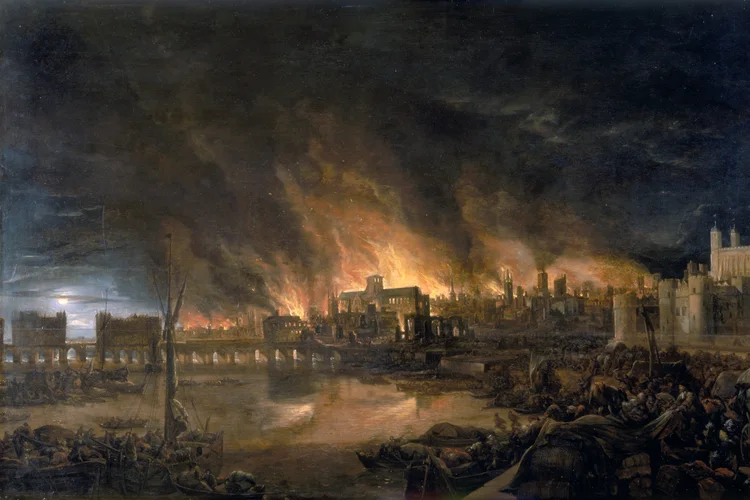
On the night of September 2, 1666, a fire broke out in a bakery on Pudding Lane. By the time it finally burned itself out four days later, the Great Fire had destroyed 88 of London's parish churches—along with St. Paul's Cathedral, 13,200 houses, and virtually the entire area within the City walls.
We have a detailed list of every church that burned, compiled by contemporaries surveying the devastation: All Hallows the Great, All Hallows the Less, All Hallows Bread Street, All Hallows Honey Lane, All Hallows Lombard Street, All Hallows Staining, All Hallows the Wall...
The list goes on and on, an alphabetical catalogue of destruction. St. Alban Wood Street, St. Andrew Hubbard, St. Andrew Wardrobe, St. Anne Blackfriars, St. Augustine Watling Street...
Some churches burned with their entire medieval contents—ancient records, medieval vestments, communion plate going back centuries. The booksellers of Paternoster Row had carried their stock into St. Paul's Cathedral for "safety," thinking surely the fire would respect the great church. They were wrong. The cathedral burned, and with it all their books.
Other losses were purely architectural but no less grievous. The medieval St. Paul's had been one of the largest cathedrals in Europe, with a spire that rose to 520 feet before being destroyed by lightning in 1561. Even without its spire, Old St. Paul's was an awesome presence. Its destruction, with flames shooting hundreds of feet into the air as the roof collapsed, was one of the most dramatic moments of the Fire.
Of the 88 churches destroyed, about 50 were eventually rebuilt—mostly by Christopher Wren, who designed 51 City churches between 1670 and 1711. The rest were not replaced. Their parishes were merged with neighbouring parishes, their churchyards became gardens or building plots, and their names gradually faded from memory.
But not entirely. If you know where to look, you can still find traces of the destroyed churches—a parish boundary marker here, a churchyard garden there, a street name preserving the memory of a vanished dedication.
Wren's New Churches: Preaching Halls, Not Medieval Shrines
Christopher Wren's task after the Great Fire was unprecedented: to design and build dozens of churches simultaneously, on cramped medieval sites, with limited budgets and demanding patrons. The result was a body of work that remains one of the glories of English architecture—but it was a decisive break with the medieval past.
Wren was a Protestant building for Protestants. His churches were designed not for the mysterious Latin mass, glimpsed through a rood screen, but for English services focused on preaching and congregational participation. Where medieval churches were long and narrow, leading the eye toward a distant altar, Wren's churches were often nearly square, bringing the congregation as close as possible to the pulpit. Where medieval churches were dark and mystical, Wren's were flooded with clear light through large plain windows. Where medieval churches were covered with paintings and carvings depicting saints and biblical scenes, Wren's were decorated with classical restraint—fine woodwork, certainly, but nothing "Popish."
The masterpiece is St. Stephen Walbrook, just behind the Mansion House. Here Wren experimented with a central dome on a Greek cross plan—a rehearsal for his great work at St. Paul's Cathedral. The interior is breathtakingly beautiful, a harmony of classical proportions and clear light that could hardly be more different from a medieval church.
Other Wren highlights include St. Mary Abchurch, with its painted dome; St. Magnus the Martyr at the foot of old London Bridge, with one of the finest church interiors in London; St. James Garlickhythe, elegantly restored after war damage; and the tower of St. Mary Somerset, one of several cases where only Wren's tower survives while the body of the church has been demolished.
Wren's steeples deserve special mention. Medieval church towers were usually fairly plain—sturdy, practical structures for hanging bells. Wren transformed the London steeple into an art form, creating elaborate confections of Portland stone that rise in stages from tower to spire. The most famous is St. Bride's Fleet Street, whose tiered steeple supposedly inspired the modern tiered wedding cake. Others include the elegant obelisk of St. Stephen Walbrook, the classical tower of St. Magnus the Martyr, and the spectacularly ornate steeple of Christ Church Newgate Street (now a ruin, its body destroyed in the Blitz and never rebuilt, but its steeple carefully preserved).
Victorian Destruction: The Churches That Survived the Fire But Not "Progress"
In some ways, the Victorians destroyed more of medieval London's church heritage than the Great Fire ever did.
The Fire burned 88 churches but left 38 standing—the churches outside the Fire's path, in the eastern and northern parts of the City. These survivors included some of the most ancient and interesting churches in London, preserving medieval architecture that the Fire had elsewhere destroyed.
But Victorian London had little patience for old buildings, especially old buildings in valuable locations. The City's population was declining as residents moved to the suburbs, and many parish churches found themselves with congregations of a few dozen souls where once there had been hundreds. At the same time, land values in the City were soaring as it transformed into a business district.
The solution seemed obvious to Victorian minds: demolish the redundant churches and use the land for offices and warehouses. Between 1831 and 1901, nineteen City churches were demolished under various Acts of Parliament. Some had survived since before the Norman Conquest.
All Hallows Bread Street was demolished in 1877. This was the church where John Milton had been baptised in 1608—arguably the greatest poet in the English language after Shakespeare. The Victorians tore it down and built offices on the site.
St. Benet Fink was demolished in 1846 to make way for the new Royal Exchange. Its parish records, going back to the medieval period, were transferred to St. Peter le Poer—which was itself demolished in 1907.
St. Antholin Budge Row came down in 1875, despite having one of Wren's most admired steeples. The steeple was removed stone by stone and re-erected in a churchyard in Sydenham, where it still stands—a strange memorial to Victorian priorities.
Not all Victorians approved. There was considerable protest against the destructions, and some churches were saved by passionate campaigners. The Society for the Protection of Ancient Buildings, founded by William Morris in 1877, grew partly from outrage at the demolition of City churches. But the protests came too late to save most of the threatened buildings.
What Survives: The Medieval Churches You Can Still Visit
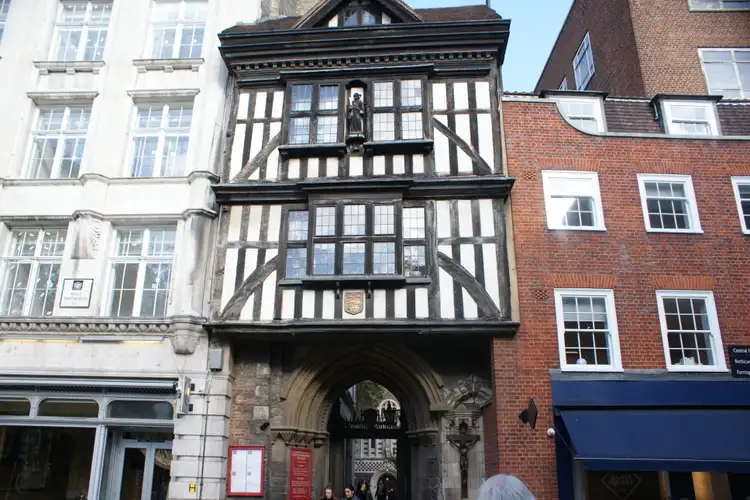
Despite Fire, Victorian demolition, and the Blitz, a handful of medieval churches still stand in the City of London. These are precious survivals, fragments of the lost forest of spires, and every visitor to London should seek them out.
St. Bartholomew the Great, Smithfield, is the most complete survival. Founded in 1123, it retains its great Norman choir, with massive round arches that haven't changed in 900 years. The Lady Chapel, the crossing, and parts of the transepts also survive from the medieval building. It's the closest you can come to experiencing the atmosphere of a medieval church in the heart of London.
The Temple Church, built by the Knights Templar in the 1160s, preserves its unique round nave—designed to recall the Church of the Holy Sepulchre in Jerusalem. The church was badly damaged in the Blitz and extensively restored, but it remains one of London's most atmospheric medieval buildings, particularly on a quiet afternoon when the tourists have gone.
St. Helen's Bishopsgate incorporates substantial medieval remains, including the nuns' church of the former Benedictine priory. The church has a remarkable collection of monuments, including tombs dating back to the fifteenth century.
St. Ethelburga's Bishopsgate was one of the smallest churches in London—barely 60 feet long. It survived the Great Fire, survived Victorian demolition, survived the Blitz... and was then destroyed by an IRA bomb in 1993. It has been carefully rebuilt and now serves as a centre for reconciliation and peace, but the medieval building is sadly lost.
St. Olave Hart Street is a rare survivor of a medieval church essentially complete. It escaped both the Great Fire and the Victorian demolitions, and while it was damaged in the Blitz, it has been well restored. Samuel Pepys worshipped here—his monument is in the church, and his wife is buried here. The churchyard gate, with its skulls and crossbones decoration, is one of London's most macabre sights.
St. Andrew Undershaft, on Leadenhall Street, is another medieval survivor. It escaped the Fire by just a few hundred yards. Inside is the monument of John Stow, the great Elizabethan antiquarian whose Survey of London (1598) remains our best source for many details of medieval and Tudor London. Every year, the Lord Mayor places a new quill pen in Stow's hand—a touching ceremony that links modern London to its historian.
All Hallows by the Tower is the oldest church in the City, with a Saxon arch dating from around AD 675. The church has been much rebuilt over the centuries, but the Saxon and Norman undercroft survives, along with a remarkable collection of historical treasures. It was from All Hallows' tower that Samuel Pepys watched the Great Fire approach.
Churches Lost to the Blitz
The second great destruction came not from fire but from German bombs.
Between September 1940 and May 1941, the Luftwaffe attacked London relentlessly. The City was hit particularly hard in the great raid of December 29, 1940—the "Second Great Fire of London"—when incendiaries created a firestorm that destroyed a huge area around St. Paul's. Miraculously, the cathedral itself survived, its dome rising above the smoke and flames in one of the most famous photographs of the war.
But other churches were not so lucky. Christ Church Newgate Street, with its magnificent Wren steeple, was gutted. The steeple still stands, but the church has never been rebuilt—it remains a ruin, now transformed into a rose garden. St. Augustine Watling Street was destroyed; its tower survives, incorporated into the choir school of St. Paul's Cathedral. St. Alban Wood Street lost everything except its tower, which stands alone in a small garden. St. Dunstan in the East was bombed in 1941, and its shell has been transformed into one of London's most romantic spots—a ruined church now overgrown with climbing plants, a secret garden in the heart of the City.
Other churches were damaged but rebuilt: St. Vedast Foster Lane, St. Mary le Bow, St. Andrew by the Wardrobe, St. Bride's Fleet Street. In each case, the restoration was careful and respectful, preserving Wren's designs while incorporating modern elements.
The Blitz destroyed what Victorian commerce and the Great Fire had spared—but it also created a new category of London church: the picturesque ruin. St. Dunstan in the East, in particular, has become a beloved London landmark, proof that even destruction can create beauty.
Why It Matters: Lessons from the Lost Churches
Why should we care about churches that vanished centuries ago?
Because they tell us who we were. Every one of those 126 parish churches was founded by real people for real reasons. The merchant who endowed a chantry chapel where priests would pray for his soul. The guild that built a church for its members. The neighbourhood that raised money to rebuild after a fire. These were expressions of community, faith, and aspiration that shaped London for a thousand years.
Because they shaped the city we still live in. Parish boundaries defined communities, and those communities defined how London governed itself. The ward structure of the medieval City—still in use today, still electing Aldermen—was closely linked to parish geography. When you vote in a City election or serve on a City jury, you're participating in a system that was shaped by those 126 churches.
Because the survivors are treasures. The handful of medieval and Wren churches that remain in the City are among the finest buildings in London. They're also under constant threat—from development pressure, from declining congregations, from simple neglect. Understanding what was lost helps us appreciate what remains and strengthens the case for preservation.
And because the names live on. Even where the churches are gone, the parishes survive in memory. Streets and lanes are still named for vanished churches. Ancient parish boundaries still determine responsibility for maintaining churchyards now turned to gardens. The ghosts of the 126 churches are all around us, if we know how to see them.
Visiting the Survivors: A Practical Guide
If you want to experience what remains of medieval London's religious landscape, here's a practical guide to the key survivors:
St. Bartholomew the Great, Smithfield
- Address: West Smithfield, EC1A 9DS
- Nearest Tube: Barbican or Farringdon
- Opening Hours: Monday-Friday 8:30am-5pm (4pm in winter), Saturday 10:30am-4pm, Sunday 8:30am-8pm (worship only until 2:30pm)
- Admission: Small charge for visitors outside service times
- Don't Miss: The Norman choir, Rahere's tomb, the medieval cloister, the Tudor gatehouse
Temple Church
- Address: Temple, EC4Y 7BB
- Nearest Tube: Temple or Blackfriars
- Opening Hours: Varies—check website. Generally Monday-Friday with some weekend opening
- Admission: Small charge
- Don't Miss: The round nave, the Templar effigies, the Purbeck marble columns
St. Helen's Bishopsgate
- Address: Great St. Helen's, EC3A 6AT
- Nearest Tube: Liverpool Street or Bank
- Opening Hours: Weekdays—check website for current times
- Admission: Free
- Don't Miss: The nuns' church, the merchant tombs, the seventeenth-century pulpit
St. Olave Hart Street
- Address: 8 Hart Street, EC3R 7NB
- Nearest Tube: Tower Hill or Fenchurch Street
- Opening Hours: Monday-Friday 9am-5pm
- Admission: Free
- Don't Miss: The skull gateway, Pepys's monument, the medieval crypt
All Hallows by the Tower
- Address: Byward Street, EC3R 5BJ
- Nearest Tube: Tower Hill
- Opening Hours: Monday-Friday 8am-6pm, Saturday-Sunday 10am-5pm
- Admission: Free (small charge for Undercroft Museum)
- Don't Miss: The Saxon arch, the Undercroft Museum with Roman pavement, the Grinling Gibbons font cover
Wren Churches to Visit
For post-Fire architecture, these Wren churches are outstanding:
- St. Stephen Walbrook (39 Walbrook, EC4N 8BN) - The dome, the Henry Moore altar, the overall harmony
- St. Mary-le-Bow (Cheapside, EC2V 6AU) - The Norman crypt, the steeple, the Bow Bells
- St. Magnus the Martyr (Lower Thames Street, EC3R 6DN) - Original pewing, position at old London Bridge
- St. Bride's Fleet Street (Fleet Street, EC4Y 8AU) - The 'wedding cake' steeple, Roman and Saxon remains in the crypt
A Final Thought
Walk through the City of London today and you walk through a palimpsest—a document written over again and again, with traces of the original still visible beneath the later layers. The 126 churches are gone, but their memory persists in street names and parish boundaries, in the handful of glorious survivors, in the very shape of the City itself.
They were built by people who believed they were building for eternity—for their own souls and the souls of their descendants, for the glory of God and the good of their community. Most of those buildings lasted barely five hundred years before fire, progress, or war swept them away. But the impulse that created them—the desire to mark sacred space, to build community, to leave something lasting—that impulse endures.
When you stand in the Norman choir of St. Bartholomew the Great, or look up at Wren's dome in St. Stephen Walbrook, or discover the secret garden growing in the ruins of St. Dunstan in the East, you're touching something that connects across the centuries. You're standing where Londoners have stood for a thousand years, doing what Londoners have always done: seeking meaning, seeking beauty, seeking community.
That's what those 126 churches were for. That's why they still matter, even now that most of them are gone.