Photo: Deror_avi / CC BY-SA 3.0 — cropped and resized
About
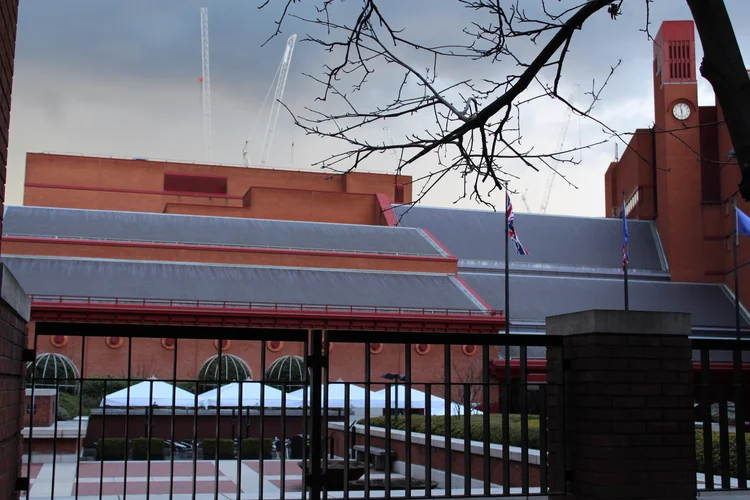
The British Library is the national library of the United Kingdom and one of the world's greatest research libraries, holding over 170 million items in virtually every written language and format imaginable. Located in a striking modernist building near King's Cross, the library serves as both a working research institution and a major public cultural venue, making its extraordinary collections accessible through free exhibitions, reading rooms, events, and digital resources.
Established by Act of Parliament in 1972, the British Library brought together the library departments of the British Museum (founded 1753), the National Central Library, and other major collections to create a unified national library. The library moved to its current purpose-built premises in 1997, leaving behind the British Museum's Round Reading Room where Karl Marx, Virginia Woolf, and countless scholars had worked. The new building by architect Colin St John Wilson accommodates the library's vast collections while providing public access to treasures previously available only to researchers.
The library's collections span 3,000 years of human thought and creativity, from ancient manuscripts to contemporary digital publications. Holdings include the Magna Carta, Gutenberg Bible, Shakespeare's First Folio, the Lindisfarne Gospels, Leonardo da Vinci's notebooks, Beatles lyrics manuscripts, and millions of books, periodicals, maps, music scores, sound recordings, patents, and databases. The collection grows by three million items annually through legal deposit, purchases, and donations, ensuring comprehensive documentation of UK publishing and selective coverage of international scholarship.
Visitors to the British Library can explore the magnificent Sir John Ritblat Gallery displaying literary and historical treasures, attend talks and exhibitions, use the extensive public reading rooms and study spaces, enjoy the café and bookshop, and experience a building designed to celebrate knowledge and learning. With free admission to public areas and exhibitions, the British Library offers unparalleled access to human knowledge and cultural heritage.
Categories:
Annual Visitors (2019)
1,500,000
Plan Your Visit
⏱️ Recommended Visit Duration
📅 Best Times to Visit
Quietest: Monday, Tuesday, Friday
Busiest: Saturday, Sunday
💡 Weekday mornings (09:30-11:00) or late afternoons (16:00-18:00) for quieter experience
💡 Visitor Tips
- Free admission to public areas and the magnificent Sir John Ritblat Gallery makes this one of London's best free cultural attractions. Plan 1-2 hours minimum to see the treasures gallery properly without rushing.
- The Ritblat Gallery displays items including Magna Carta, Gutenberg Bible, and Lindisfarne Gospels - some of civilization's most important documents. Take time to read interpretive panels explaining each item's significance. Photography allowed (no flash).
- Visit on weekday mornings or late afternoons for the quietest experience. Weekends and lunchtime (12:00-14:00) are busiest. The library is popular with tourists, researchers, and local workers, creating steady visitor traffic.
- If you want to use the reading rooms to consult library materials, you need to register for a reader's pass (free, requires proof of identity and address). Register online before visiting to save time. Public areas don't require registration.
- The on-site café and restaurant serve decent food with reasonable prices for central London. The café gets busy at lunchtime - consider eating before/after noon rush or bringing snacks for the courtyard.
- Don't miss the King's Library tower in the central atrium - this spectacular six-story glass tower housing King George III's 65,000 books is visible from multiple floors and represents the architectural heart of the building.
- The library shop is excellent for book lovers, selling rare facsimiles, literary gifts, stationery, and publications about the collections. Budget time and money if you appreciate bookshops - it's one of London's best.
- Check the events calendar before visiting - the library hosts free talks, workshops, and performances regularly. The building also hosts excellent temporary exhibitions (some paid, some free).
- The library is next to St Pancras and King's Cross stations, making it perfect to combine with arrival/departure if you're traveling by train. Secure bag storage available if needed for heavy luggage.
Highlights
The Magna Carta (1215)
The British Library holds two of the four surviving original exemplifications of Magna Carta from 1215, the foundational document of constitutional government and individual liberty. King John sealed the Great Charter at Runnymede in June 1215 under pressure from rebellious barons demanding limits on royal power.
Though the 1215 version was quickly annulled and most of its clauses are now obsolete, Magna Carta established the revolutionary principle that the monarch is subject to law, not above it.
The document's influence on constitutional development worldwide - from the US Constitution to the Universal Declaration of Human Rights - makes it one of history's most significant legal texts. The library's copies, damaged by age and fire (one partially burned in 1731), are preserved with meticulous care and displayed under carefully controlled conditions.
The dense Latin text written on vellum in medieval script demonstrates medieval documentary practice.
Seeing these fragile, 800-year-old documents brings constitutional history tangibly to life and connects modern democratic freedoms to their medieval roots.
Gutenberg Bible (c. 1455)
The library holds two complete copies and fragments of additional copies of the Gutenberg Bible, the first substantial book printed in Europe using movable metal type. Johannes Gutenberg's invention in Mainz around 1450-1455 revolutionized knowledge transmission, making books affordable and accelerating the spread of ideas that fueled the Renaissance, Reformation, and Scientific Revolution.
Before printing, books were laboriously hand-copied by scribes, making them rare and expensive.
Gutenberg's Bible printed around 180 copies in about two years - production previously impossible. The printed text mimics manuscript script so closely that early readers often couldn't distinguish printed from handwritten books. The library's copies show the extraordinary quality of Gutenberg's craftsmanship, with crisp black letter gothic type, hand-illuminated initials, and fine vellum pages.
This invention ranks among humanity's most transformative technologies, democratizing knowledge and enabling the modern world. Standing before these volumes printed over 560 years ago connects visitors to the information revolution's origins.
The Lindisfarne Gospels (c. 700 AD)
This breathtaking illuminated manuscript, created around 700 AD on Holy Island (Lindisfarne) off the Northumberland coast, represents the pinnacle of Anglo-Saxon artistry and one of Europe's finest medieval manuscripts. Made by a single monk, probably Eadfrith, Bishop of Lindisfarne, to honor St Cuthbert, the gospels contain the four Biblical gospels copied in Latin with later Old English translation added between the lines in the 10th century.
The manuscript's illuminations are extraordinarily sophisticated, combining Celtic, Germanic, and Mediterranean artistic influences in intricate carpet pages, decorated initials, and evangelist portraits demonstrating remarkable skill and patience.
The geometric precision, vibrant pigments (some imported from as far as Afghanistan), and minuscule detail required superhuman dedication - the monk worked with quills, grinding minerals for pigments, working by candlelight in a cold stone monastery. The manuscript survived Viking raids (fleeing monks dropped it in the sea, miraculously preserving it), dissolution of monasteries, and civil wars.
It represents Christian faith, artistic achievement, and cultural synthesis from early medieval England.
Shakespeare First Folio (1623)
The British Library holds several copies of the First Folio of Shakespeare's plays, published in 1623 seven years after the playwright's death by his theatre company colleagues. This book preserved 18 plays that might otherwise have been lost forever, including Macbeth, Julius Caesar, The Tempest, and Twelfth Night, which had never been printed.
Without the First Folio, half of Shakespeare's dramatic output would likely have disappeared.
Only about 750 copies were originally printed; approximately 235 survive today. The Folio's compilers, John Heminges and Henry Condell, described their mission as preserving Shakespeare's works 'absolute in their numbers, as he conceived them. ' The library's copies include the extensively annotated copy owned by actor David Garrick, showing how Shakespeare was read and performed in the 18th century.
The First Folio represents not just literary preservation but the birth of Shakespeare's enduring cultural influence. Its publication ensured that the world's most-performed playwright's works survived, shaping theatre, literature, and language for four centuries.
Collections
The British Library holds over 170 million items representing virtually every written language, format, and subject, making it one of the world's most comprehensive knowledge collections. Holdings include 14 million books, 920,000 journal and newspaper titles, 8 million stamps and philatelic items, 4 million maps, 310,000 manuscript volumes, 6.
5 million sound recordings, 3.
5 million patents, and vast quantities of digital materials. The collection spans 3,000 years from ancient Sumerian tablets to contemporary digital publications. Strengths include unparalleled British and Irish publishing coverage (legal deposit ensures the library receives copies of every UK publication), exceptional historical manuscripts and archives, comprehensive map collections, outstanding Asian and African collections, the world's most important philatelic collection, and the national sound archive.
The library acquires three million new items annually through legal deposit, purchase, and donation. Digital collections are growing rapidly, with extensive digitization programs making millions of items accessible online. The collections serve researchers worldwide while supporting exhibitions and public programs that make treasures accessible to everyone.
Sir John Ritblat Gallery: Treasures of the British Library
This permanent exhibition displays over 200 of the library's most precious items spanning 3,000 years of human thought and creativity. Highlights include Magna Carta, Gutenberg Bible, Lindisfarne Gospels, Shakespeare First Folio, Leonardo da Vinci notebooks, the Diamond Sutra (world's earliest dated printed book, 868 AD), Jane Austen manuscripts, Handel music scores, Beatles lyrics, and countless other treasures.
The gallery groups items thematically, showing connections between objects from different periods and cultures.
World-class conservation and display conditions protect these fragile items while making them visible to the public. This gallery offers unparalleled access to documents that shaped civilization, presented in an elegant, contemplative space designed to encourage close looking and reflection.
📍 Ground Floor
The King's Library Tower
This dramatic six-story glass tower showcasing King George III's 65,000-volume library forms the architectural and symbolic heart of the British Library building. The tower makes knowledge visible throughout the building, representing the Enlightenment ideal of learning as civilization's foundation.
Though the books are not accessible to casual visitors, the tower's beauty and the sheer quantity of leather-bound volumes create a powerful statement about the permanence and value of libraries.
Information panels explain the collection's history and George III's bibliophile passion.
📍 Central atrium
Themes
Time Periods
Current Exhibitions
No current exhibitions. Please check the museum website for updates.
Nearby Museums (5 within 6 miles)
The Foundling Museum
London — ~8 min walk (0.4 mi)
Petrie Museum of Egyptian Archaeology
London — ~9 min walk (0.5 mi)