FitzStephen's London: A Day in the Life of 12th Century London
Who Was William FitzStephen?
We know frustratingly little about FitzStephen himself. He was a clerk—an educated man in holy orders, employed in administrative work. He served Thomas Becket both when Becket was Henry II's chancellor (effectively the king's chief minister) and later when Becket became Archbishop of Canterbury. He was present in Canterbury Cathedral on 29 December 1170, when the four knights burst in and murdered the archbishop at vespers.
FitzStephen clearly loved his master and loved his city. His description of London glows with civic pride—he calls it 'the most noble city' and compares it favourably to Rome itself. Some of his claims are obviously exaggerated, but his observations about daily life have the ring of truth. This is a man describing the city he knew intimately, not copying from books or repeating rumours.
After Becket's death, FitzStephen wrote his biography (the Vita Sancti Thomae) probably in the 1170s. He seems to have died not long after—we have no records of him after about 1182. But his description of London lived on, copied and recopied through the Middle Ages, recognised even then as something precious and unique.
A City of Churches
FitzStephen begins his description with London's religious geography, and the numbers are staggering:
It has on the east the Palatine Castle, very great and strong, whose walls and bailey rise from very deep foundations. On the west are two castles very strongly fortified, and from thence the Wall runs continuously, high and great, with seven double gates and with towers along the north at regular intervals.
— William FitzStephen, Description of London
The City has thirteen larger conventual churches and one hundred and twenty-six lesser parish churches.
— William FitzStephen
One hundred and twenty-six parish churches. Plus thirteen great churches belonging to monasteries, priories, and religious houses. In a city that probably contained no more than 40,000 people.
Think about what this means in practical terms. Almost every street had its own church. The bells would have been ringing constantly—for services, for curfew, for weddings, for funerals, for the hours of the monastic day. You could not have walked more than a minute or two in any direction without passing a church door.
This was a society that invested enormous resources in sacred building. The churches were not just places of worship but community centres, social clubs, welfare offices, and the primary markers of neighbourhood identity.
The Schools of London
FitzStephen was an educated man, and he takes obvious pride in London's schools:
In London, three principal churches have, by privilege and ancient dignity, famous schools. On holy days, the masters of the schools assemble their scholars at the churches whose feast it is. The scholars dispute, some in demonstrative rhetoric, others in dialectic.
— William FitzStephen
This is a picture of competitive, public education—students from rival schools debating in church forecourts on feast days, trading insults in Latin verse, showing off their mastery of rhetoric and logic. The 'three principal churches' were probably St Paul's Cathedral, St Martin le Grand, and St Mary le Bow (or possibly Holy Trinity Aldgate).
But FitzStephen also mentions less formal schools 'permitted on sufferance'—unlicensed teachers setting up shop wherever they could find pupils. Medieval London, it seems, had an educational free market. Anyone with enough learning and enough charisma could attract students.
Thomas Becket himself was a product of London's schools. Born on Cheapside, probably around 1120, he attended the school of one of the priories before going to Paris for advanced studies. His trajectory from London schoolboy to chancellor of England to archbishop to martyr to saint was one of the great careers of the medieval world—and it began in the schoolrooms FitzStephen describes.
Cheapside: The Great Market
When we say 'Cheapside' today, we mean a street—a rather ordinary City street running from St Paul's to the Bank of England. But FitzStephen's Cheapside was no ordinary street. It was London's great open market, the commercial heart of the city, a vast trading space where you could buy virtually anything.
The name itself tells the story. 'Cheap' comes from the Old English ceap, meaning 'market' or 'bargain' (hence our word 'cheap' meaning inexpensive). Cheapside was the market-side, the market-place. And what a market it was.
Those engaged in the several kinds of business, sellers of several things, contractors for several kinds of work, are distributed every morning into their several localities and shops. Besides, there is in London on the river bank, among the wines in ships and cellars sold by the vintners, a public cook-shop.
— William FitzStephen
- Bread Street was where the bakers sold
- Milk Street was for dairy
- Wood Street was the timber market
- Honey Lane sold honey (essential for sweetening in an age before cheap sugar)
- Friday Street sold fish—the food for fast days when meat was forbidden
- Poultry (still a street name today) was the poultry market
- Ironmonger Lane was for ironworkers
This wasn't just convenient organisation—it was legally required. Medieval cities strictly regulated where different trades could operate. Butchers had to slaughter in designated areas (the 'shambles'). Tanners, whose work produced terrible smells, were pushed to the city's edge. Goldsmiths clustered together so they could be more easily supervised.
Cheapside itself was broader than a modern street—more like a wide marketplace with permanent shops on either side and temporary stalls set up in the middle. On market days, it would have been packed with people: merchants crying their wares, customers haggling over prices, apprentices running errands, beggars seeking alms, pickpockets (called 'cutpurses' because they literally cut the strings of the purses that hung from people's belts) looking for opportunities.
The River and the Bridge
FitzStephen knew that London's wealth came from the Thames:
The City of London has given great and many proofs of its worth since its foundation; and has been enriched by the most noble citizens. It sends out from its port ships which may be numbered by thousands to buy and sell merchandise.
— William FitzStephen
The Thames was London's highway. In an age of terrible roads—rutted, muddy, and infested with bandits—the river offered smooth, safe transport. Goods came up from the coast and from overseas; they went out to the continent and beyond. Every major London merchant had his own wharf or access to one.
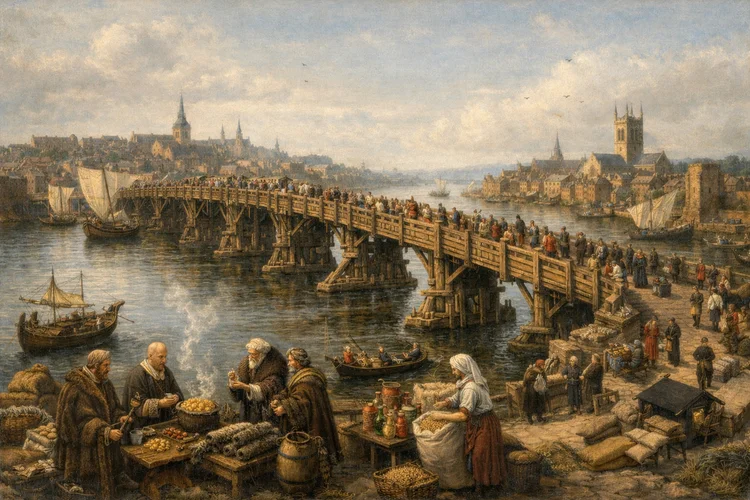
London Bridge, in FitzStephen's time, was still the wooden bridge that had been rebuilt after various disasters. (The great stone bridge, with its houses and shops, wouldn't be completed until around 1209.) But even the wooden bridge was a marvel—the only bridge across the Thames downstream from Kingston, the vital link between London and Southwark.
To this city, from every nation under heaven, merchants delight to bring their trade by sea. Arabia sends gold; Scythia sends furs; Saba sends incense; Russia sends amber; Gaul sends wine; and our own rivers and mills supply us abundantly with corn.
— William FitzStephen
Sports and Entertainments
FitzStephen's account of London's entertainments is one of the most detailed and delightful sections of his description. Medieval Londoners, it seems, loved their sports.
Ball Games
Every year on Shrove Tuesday—that we may begin with the games of boys, for we were all boys once—the schoolboys bring their fighting-cocks to their master, and the whole forenoon is given up to boyish sport. After dinner all the youth of the city go out into the fields to play at the well-known game of ball.
— William FitzStephen
The 'ball' in question was probably an early form of football—a rough, violent affair with few rules and many injuries. Different trades and different schools would form teams and compete against each other. The goals might be miles apart. There was no limit to the number of players. It was less a sport than an organised riot.
Horse Racing
At Smithfield:
Every Friday, unless it be a solemn feast-day, there is a much frequented show of fine horses for sale. When a race between such trampling steeds is about to begin, a shout is raised and orders are given that the common horses should be led apart: three jockeys make ready. At the signal they stretch out their limbs, gather up their speed, and dash onwards with a zeal that knows no stint.
— William FitzStephen
Horse racing at Smithfield! FitzStephen describes a genuine race meeting—matching horses against each other for sport, with crowds of spectators, from earls to citizens. This was centuries before Newmarket or the Jockey Club, but the essential elements of horse racing were already in place.
Ice Skating
FitzStephen provides one of the earliest descriptions of ice skating in English history:
When the great marsh that washes the walls of the City on the north side is frozen, crowds of young men go out to amuse themselves on the ice. Some fit to their feet the shin-bones of animals, binding them firmly about their ankles, and with an iron-shod pole, which they strike against the ice from time to time, they propel themselves as swiftly as a bird in flight.
— William FitzStephen
This is one of the earliest descriptions of ice skating in English history. The 'great marsh' is Moorfields—the boggy ground north of the City wall that would freeze in cold winters. The skates were literally animal bones, strapped to the feet. The 'iron-shod pole' was for propulsion and balance (and apparently for jousting).
The Character of the Citizens
FitzStephen's description of London's people is both flattering and revealing:
The citizens of London are everywhere regarded as illustrious and renowned beyond those of all other cities for the elegance of their fine manners, raiment and table. The inhabitants of other towns are called citizens, but those of London are called Barons.
— William FitzStephen
'Barons' here doesn't mean nobility—it's a term for the leading citizens of certain privileged towns, implying that Londoners ranked with the great men of the realm. This was more than just local boasting; London's wealth and strategic importance gave its citizens genuine political weight.
But FitzStephen is also honest about London's faults:
The only pests of London are the immoderate drinking of fools and the frequency of fires.
— William FitzStephen
Two vices, and only two—but significant ones. Drunkenness was indeed a medieval problem; ale and wine were safer to drink than water (which might be contaminated). As for fire, medieval London burnt with depressing regularity. Wooden houses packed closely together, open hearths, candles and rushlights—the wonder is not that London suffered terrible fires but that any of it survived from one century to the next.
What You Can Still See Today
FitzStephen's London has largely vanished. The Great Fire of 1666 destroyed almost everything within the walls. Victorian development swept away much of what the Fire spared. Yet traces of FitzStephen's world can still be found, if you know where to look.
St Bartholomew the Great
Of all the medieval buildings in London, St Bartholomew the Great comes closest to what FitzStephen would have known. Founded in 1123—just fifty years before FitzStephen wrote—this priory church preserves its Norman choir essentially intact. The great round arches, the massive cylindrical columns, the shadowy triforium above—this is 12th-century architecture, the architecture of FitzStephen's London.
- Address: West Smithfield, EC1A 9DS
- Nearest Tube: Barbican or Farringdon
- Opening Hours: Monday-Friday 8:30am-5pm (4pm winter), Saturday 10:30am-4pm
The Temple Church
The Knights Templar built their round church in the 1160s—exactly when FitzStephen was writing. He would certainly have known it. The circular design, based on the Church of the Holy Sepulchre in Jerusalem, was unique in London and remains extraordinary today.
- Address: Temple, EC4Y 7BB
- Nearest Tube: Temple or Blackfriars
- Opening Hours: Vary—check website
Smithfield
FitzStephen describes Smithfield as the place where horses were traded and raced. It remained London's livestock market until 1855. Today it's home to the meat market (the magnificent Victorian buildings date from the 1860s) and to St Bartholomew the Great and St Bartholomew's Hospital.
The great open space where FitzStephen's young men raced horses is now largely built over, but the area retains something of its medieval character—a little enclave of older London surrounded by modern development.
Cheapside
FitzStephen's great market is now an ordinary City street, lined with modern buildings. But the street names around it preserve the medieval market's geography: Bread Street, Milk Street, Honey Lane, Wood Street, Poultry, Ironmonger Lane. Walk from St Paul's to the Bank along Cheapside, and you're following the route that medieval Londoners took through the heart of their commercial world.
The Tower of London
FitzStephen mentions 'the Palatine Castle'—the Tower—at the very beginning of his description. The White Tower, the massive Norman keep at the centre of the complex, was already standing when FitzStephen wrote. It had been built by William the Conqueror starting in the 1070s. This is one building FitzStephen would instantly recognise.
- Address: Tower Hill, EC3N 4AB
- Nearest Tube: Tower Hill
- Admission: Charge applies
A Final Thought
William FitzStephen loved his city. That shines through every line of his description—the pride in London's churches and schools, the delight in its sports and spectacles, the affection for its citizens and their foibles. He wrote to celebrate, not to criticise.
Yet there's a shadow over his celebration. FitzStephen wrote in the aftermath of murder—the murder of his master, Thomas Becket, in a cathedral in Canterbury. The life of Becket that FitzStephen introduces with his London description is a story of conflict between church and state, conscience and power, that ended in blood on a cathedral floor.
When you walk through the City of London today, you walk where FitzStephen walked eight and a half centuries ago. The buildings are different; the streets have shifted; the population has multiplied a hundredfold. But something of FitzStephen's London persists—in the love of commerce, in the civic pride, in the curious mixture of hard-headedness and sentiment that still characterises London and Londoners.
— Contemporary reflection