The Seven Sisters: Sussex's Ancient Coast
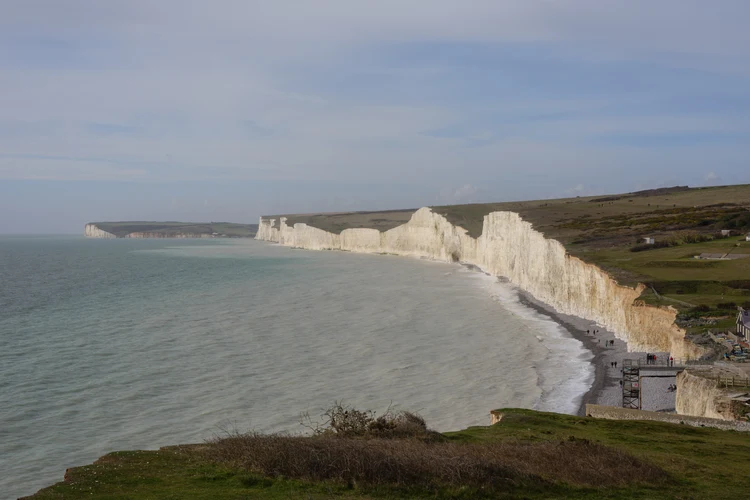
The Making of the Cliffs: A Geological Story
Before we can understand the human history of this coast, we need to understand the cliffs themselves. Where did all this chalk come from?
The answer takes us back about 100 million years, to the Cretaceous period. Britain didn't exist then—not as we know it. The landmass that would become England lay beneath a warm, shallow sea. In that warm sea, countless billions of microscopic organisms lived and died. Their shells—made of calcium carbonate—drifted down to the seabed, accumulating in layers that grew thicker over millions of years. Compressed by their own weight, these shells became chalk.
Within the chalk lies flint—nodules of extremely hard silica, formed from the remains of sea sponges. Flint is dark grey or black, utterly different from the white chalk around it. And for our prehistoric ancestors, flint was the most important material in the world.
The First Humans: 500,000 Years of Occupation
Humans have been present in Sussex for an almost inconceivable length of time. The earliest evidence comes from Boxgrove, a site near Chichester about 25 miles west of the Seven Sisters. Here, archaeologists have found flint tools and butchered animal bones dating back approximately 500,000 years.
The Boxgrove people were Homo heidelbergensis, an earlier human species, and they were hunting horses and rhinoceroses on what was then an African-style savanna. The Boxgrove discoveries include a leg bone (tibia) from one of these ancient humans—the oldest human bone ever found in Britain.
Between Boxgrove and recorded history stretches an immense span of time—ice ages and warm periods, extinctions and migrations, the coming and going of different human species. Modern humans reached Britain perhaps 40,000 years ago, but were repeatedly driven out by glacial advances.
— Archaeological Timeline
The Flint Miners: Neolithic Sussex
By about 4000 BC, the people of Sussex had discovered the richest resource in the chalk hills: flint. Flint was essential for Neolithic life. It could be knapped (shaped by striking) into razor-sharp blades, arrowheads, scrapers, axes, and dozens of other tools.
Sussex had good flint. Very good flint. And the Neolithic inhabitants exploited it on an industrial scale.
Cissbury Ring, on the South Downs north of Worthing, is best known as one of Britain's largest Iron Age hillforts. But before the Iron Age people built their fort, Neolithic miners had already been working the site for over 2,000 years.
- The Neolithic flint mines at Cissbury consist of over 200 shafts, some reaching 40 feet into the chalk
- The miners dug down until they reached the best flint layers, then excavated horizontal galleries
- They worked by the light of tallow lamps, using antler picks to loosen the chalk
- Similar mines existed at Church Hill near Findon, at Blackpatch near Worthing, and at Grimes Graves in Norfolk
Hillforts and Burial Mounds: Bronze and Iron Age Sussex
The chalk downs behind the Seven Sisters are dotted with prehistoric monuments—burial mounds, hillforts, field systems that speak of intensive occupation over thousands of years.
Round barrows—circular burial mounds—are everywhere on the South Downs. They date mostly from the Bronze Age (roughly 2500-800 BC), when important individuals were buried with grave goods under mounds of earth and chalk.
By the Iron Age (roughly 800 BC to AD 43), society had become more complex—and more violent. Hillforts appeared across the South Downs: massive enclosures defended by banks, ditches, and wooden palisades.
Roman Sussex: Villas, Roads, and a Palace
When the Romans invaded Britain in AD 43, Sussex was ruled by a tribe called the Atrebates. The king, Togidubnus, was a Roman client who may have assisted the invasion. In return, he was rewarded with a level of luxury that British chieftains had never known.
Fishbourne Roman Palace, near Chichester, is the most spectacular Roman building ever discovered in Britain. It was built around AD 75, probably for Togidubnus himself. It was enormous—larger than Buckingham Palace—with formal gardens, underfloor heating, bath suites, and mosaic floors of stunning quality.
The mosaics alone would make Fishbourne remarkable; some are among the finest in northern Europe. The palace burned down around AD 270 and was never rebuilt. But the remains survived until their accidental discovery in 1960.
— Archaeological Discovery
Beyond Fishbourne, Roman Sussex was prosperous farmland. Villas dotted the coastal plain. The villa at Bignor, inland from the Seven Sisters, has famous mosaics including a 79-foot-long example that's one of the longest in Britain.
The Long Man of Wilmington: A Chalk Figure Mystery
On the northern escarpment of the South Downs, just inland from the Seven Sisters coast, a giant human figure is carved into the chalk hillside. The Long Man of Wilmington is about 235 feet tall—one of the largest representations of a human being in the world.
Who made him? When? Why? Nobody knows for certain. The Long Man is one of England's great archaeological mysteries.
- The earliest definite record dates from 1710
- No medieval references, no Roman mentions exist
- Modern research suggests it may be 16th or 17th century, not prehistoric
- Theories include: prehistoric god, Roman figure, medieval pilgrim, surveyor's tool, monastic folly
1066: The Norman Invasion
On 28 September 1066, the Norman invasion fleet landed on the Sussex coast. Not at Dover—that would come later. Not at the Seven Sisters—the cliffs are too steep. But just a few miles to the east, at Pevensey, where a sheltered bay offered safe anchorage for William's 700 ships.
This was the invasion that changed England for ever. Within three weeks, the last Anglo-Saxon king would be dead, the Norman conquest would be complete, and the country would enter a new era.
Pevensey was already ancient when William arrived. The Romans had built a massive fort here—Anderitum—one of the Saxon Shore forts. The walls still stand, among the best-preserved Roman walls in Britain: 12 feet thick, 25 feet high in places.
Harold's army, exhausted from defeating a Norwegian invasion at Stamford Bridge, force-marched south. They met William on 14 October 1066, at a site about six miles inland from Hastings. The battle lasted all day. Harold was killed, and William marched on London.
Battle Abbey now stands on the site where Harold fell—William founded it as penance for the bloodshed, and the high altar supposedly marks the spot where Harold died. The battlefield is preserved, and a visitor centre explains the events of that world-changing day.
— Battle of Hastings
Medieval Sussex: Ports, Castles, and Sheep
In the centuries after the Conquest, Sussex settled into a pattern: ports along the coast, castles controlling strategic points, and sheep—countless thousands of sheep—grazing the chalk downland.
The wool trade made medieval Sussex wealthy. The South Downs were ideal sheep country. Sussex wool was exported to Flanders and Italy. The great medieval sheep fairs drew buyers from across Europe.
The Seven Sisters Today: A Visitor's Guide
The Seven Sisters Country Park
- Location: Between Seaford and Eastbourne, accessed from the A259
- Parking: Pay parking at Exceat (Seven Sisters Country Park Visitor Centre)
- Cuckmere Haven: Walk down the valley (about 1 mile) to the beach
- The Seven Sisters Walk: Challenging 6-mile clifftop walk. Allow 3-4 hours. Views are spectacular
Key Historical Sites
Pevensey Castle: Roman walls, Norman keep, 1066 exhibition. English Heritage.
Battle Abbey and Battlefield: Where the 1066 battle took place. English Heritage.
Fishbourne Roman Palace: Extraordinary mosaics, Britain's largest Roman building. Don't miss the Cupid on a Dolphin mosaic.
Bignor Roman Villa: The 79-foot-long mosaic corridor is one of the longest in Britain. Seasonal opening.
The Long Man of Wilmington: Best viewed from the road below. Free access.
Walking the South Downs Way
The South Downs Way is a 100-mile National Trail running from Winchester to Eastbourne. The final section follows the clifftops over the Seven Sisters and past Beachy Head—about 10 miles of spectacular walking, with the chalk cliffs on your right and the English Channel stretching to the horizon.
A Final Thought
The Seven Sisters are not the most famous cliffs in England. They don't have the historic resonance of Dover. But in some ways, that's the point.
The Sussex coast is ancient in the sense of deep time, long occupation, layer upon layer of human activity across thousands of years. The flint miners dug here 5,000 years ago. Bronze Age chieftains were buried under mounds that still mark the skyline. Iron Age warriors built hillforts. Romans laid out villas. Normans raised castles. And through all of that, the cliffs kept forming, the waves kept eroding, the chalk kept falling into the sea.
— Geological and Human Time
Stand on the clifftops at sunset, when the light turns the chalk to gold, and look out over the Channel. This coast has seen everything. It will see whatever comes next. And it will still be here, white and enduring and beautiful, long after we're gone.