St Bartholomew's Hospital: 900 Years of Healing
Rahere's Vision
Who was Rahere? The medieval accounts call him a 'joculator'—a jester or entertainer—at the court of Henry I. Whether this means he was literally a clown, or simply a witty courtier who amused the king, we don't know. What we do know is that he was well-connected, probably wealthy, and deeply troubled about his eternal fate.
Medieval people worried about salvation in ways that are hard for modern minds to grasp. They believed—really believed—in heaven and hell, in purgatory and judgement, in the accounting that would be demanded of every soul. And they knew that wealth and comfort were spiritually dangerous. 'It is easier for a camel to go through the eye of a needle,' Christ had said, 'than for a rich man to enter into the kingdom of God.'
What could a rich man do? He could give his wealth away. He could found monasteries where monks would pray for his soul. He could build hospitals where the poor—Christ's special friends—would be cared for in his name. These were not acts of charity in the modern sense; they were investments in eternity, insurance policies against damnation.
Rahere's pilgrimage to Rome was itself such an investment. But then he fell ill, and in his fevered dreams, he had a vision. St Bartholomew appeared to him—the apostle who had been flayed alive for his faith—and commanded him to build a church and hospital at Smithfield, outside the walls of London.
Rahere recovered and returned to England. He went to King Henry I and secured permission to build. He went to the Bishop of London and obtained ecclesiastical authority. And then he went to Smithfield—a marshy, undesirable area outside the City walls, used for horse trading and public executions—and began to dig foundations.
The church came first: the great priory church of St Bartholomew, whose Norman choir still stands today as the oldest church interior in London. But almost immediately, Rahere also established a hospital 'for the restoration of poor men.' The hospital and the priory were separate institutions, served by the same community of Augustinian canons—monks who combined the contemplative life with active service to the world.
A Medieval Hospital: What Was It Really Like?
Forget everything you know about hospitals. A medieval hospital was nothing like a modern medical centre.
There were no doctors in the modern sense—no medical degrees, no stethoscopes, no understanding of germs or antibiotics. Surgery existed, but it was primitive, agonising, and frequently fatal. Most illnesses were untreatable; medieval medicine consisted largely of prayer, herbal remedies of uncertain effectiveness, and what we would now call palliative care.
What a hospital provided was shelter, food, warmth, and spiritual comfort. The sick poor of London—and there were many—might die in the streets if no one took them in. A hospital gave them a bed (shared with three or four other patients), regular meals, and the constant prayers of the religious community.
- Capacity: The original hospital probably had space for forty or fifty patients
- Layout: Patients slept in a single great hall—the infirmary—with an altar at one end where mass was said daily
- Patients: Mostly men—women were cared for in separate establishments—and overwhelmingly poor
- Food: Bread, pottage (a thick soup or stew), ale, occasionally meat or fish
- Treatment: Rest, food, and prayer. If you had a disease that could heal itself, the hospital gave you time to recover
Dissolution and Refoundation
In 1539, Henry VIII dissolved the monasteries. The Dissolution was one of the great upheavals of English history—the seizure of Church property that transferred a quarter of England's land from ecclesiastical to secular hands.
St Bartholomew's Priory was dissolved along with the rest. The great priory church was partially demolished—the nave was torn down, the crossing and transepts disappeared, and only the choir remained, becoming the parish church of a much-reduced parish.
But what about the hospital? Here the story takes an unexpected turn. The City of London petitioned Henry VIII to spare the hospital. London needed somewhere to care for its sick poor, the citizens argued. Without St Bartholomew's, the sick would die in the streets.
Henry agreed—eventually. The hospital was refounded in 1546, just a year before Henry's death, with a royal charter that established it as a civic institution under the governance of the City of London. It was no longer a religious house; it was now a public hospital, funded by city revenues and charitable donations, governed by a board of citizens rather than by monks.
This refoundation is why St Bartholomew's has the character it does today. Unlike the monastic hospitals of the continent, which remained religious institutions, Barts became a secular, civic enterprise. Its orientation shifted from spiritual care to medical treatment.
— Historical Analysis
The Henry VIII Gate, which still stands as the main entrance to the hospital, commemorates this refoundation. The statue of Henry VIII above the entrance—the only outdoor statue of the king in London—is a reminder that Barts owes its survival to the most unlikely of saviours: the king who destroyed so much else.
The Hospital Grows: 17th to 19th Centuries
The centuries after the refoundation saw St Bartholomew's grow from a medieval charity into a major medical institution.
In 1609, the hospital established a school for training surgeons—one of the earliest medical schools in England. The surgeons of Barts were barber-surgeons initially, members of the Barber-Surgeons' Company, who combined cutting hair with cutting flesh. But gradually, surgery professionalised.
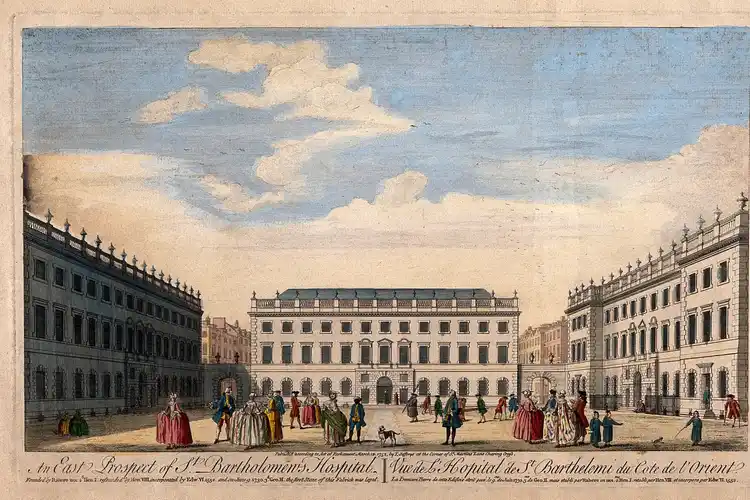
The hospital buildings were rebuilt in the 18th century, replacing the medieval structures with the elegant Georgian blocks that still form the core of the hospital today. The great square, designed by James Gibbs, is one of the finest examples of institutional architecture in London. The staircase walls were painted by William Hogarth—two massive biblical scenes, The Pool of Bethesda and The Good Samaritan, given free by the artist as a charitable gift and still in place today.
Great Physicians of Barts
- William Harvey, who discovered the circulation of the blood, was Chief Physician from 1609 to 1643. He conducted his groundbreaking experiments whilst treating patients at the hospital
- Percivall Pott, the 18th-century surgeon, made so many contributions to surgery that several conditions still bear his name: Pott's fracture, Pott's disease, Pott's puffy tumour
- James Paget, the 19th-century surgeon and pathologist, described Paget's disease of bone and Paget's disease of the nipple. He was one of the founders of scientific pathology
The 19th century brought revolution. Anaesthesia arrived in the 1840s—suddenly surgery could be performed without the patient screaming in agony. Antisepsis came in the 1860s—suddenly patients stopped dying of infection after operations. X-rays appeared in the 1890s—suddenly doctors could see inside the living body. Each breakthrough transformed what hospitals could do, and Barts was at the forefront of many of them.
'The Body in the Kitchen': Barts in Literature
St Bartholomew's Hospital has a famous literary connection that brings visitors from around the world.
In Arthur Conan Doyle's A Study in Scarlet (1887), Dr John Watson—newly returned from Afghanistan, wounded and unemployed—is looking for affordable lodgings in London. A friend finds him at the Criterion Bar and mentions knowing someone else seeking a roommate. 'You don't know Sherlock Holmes yet,' the friend says. 'Come along and meet him.'
They go to St Bartholomew's Hospital, where Sherlock Holmes is working in the chemical laboratory.
You have been in Afghanistan, I perceive.
— Sherlock Holmes to Dr Watson, their first meeting
It is the first meeting of the most famous partnership in detective fiction. And it happens at Barts.
Conan Doyle was himself a physician—he had studied medicine at Edinburgh—and he knew hospital laboratories well. His choice of Barts as the meeting place was deliberate: it was London's oldest and most prestigious hospital, exactly where an eccentric consulting detective might pursue chemical experiments.
The connection has been commemorated in various ways. There's a plaque in the hospital's pathology building. The museum displays Holmes-related material. And fans still come to see where the great detective and his biographer first met.
The Blitz and After
On the night of 29 December 1940—the 'Second Great Fire of London'—German incendiary bombs rained down on the City. The area around Barts was hit hard. The hospital's Great Hall was damaged, and several wards were destroyed. But the hospital kept functioning, treating casualties even as bombs fell around it.
After the war, Barts became part of the National Health Service. The great hospital that had been founded as a religious charity, refounded as a civic institution, and developed as a voluntary hospital was now absorbed into the state system.
In 1993, the hospital faced its greatest modern crisis. A government report recommended closing Barts entirely, arguing that its central London location was inefficient. The proposal provoked furious opposition—from staff, from former patients, from the City of London, from Londoners who couldn't imagine their city without its oldest hospital.
Barts survived. It was merged with the Royal London Hospital to form Barts Health NHS Trust. Some services were moved; some buildings were demolished. But the hospital continues to operate on its ancient site, providing specialist cardiac, cancer, and trauma services.
St Bartholomew the Great: The Priory Church
You cannot understand Barts Hospital without understanding its sister foundation, the Priory Church of St Bartholomew the Great.
This is the church that Rahere built, or rather, what remains of it. The great Norman choir—with its massive round arches, its cylindrical columns, its shadowy triforium gallery—survives essentially unchanged from the 12th century. This is the oldest surviving church interior in London, and one of the finest examples of Norman architecture in England.
When Henry VIII dissolved the priory, the nave was demolished and sold for building materials. The crossing and transepts disappeared. Only the choir was preserved, becoming the parish church of a small parish.
Rahere's tomb is in the choir, on the north side. The canopy and effigy are early 16th century—rebuilt by Prior Bolton—but they may incorporate earlier elements. Rahere himself lies beneath, where he was buried in 1143.
Enter through the Tudor gatehouse (look up—there's a half-timbered house from 1595 above the arch) and step into another world. The Norman arches, the filtered light, the ancient stones—it's the closest you can come to medieval London in the heart of the modern city.
Visiting Barts: A Practical Guide
St Bartholomew's Hospital
- Address: West Smithfield, EC1A 7BE
- Nearest Tube: Barbican or Farringdon
- Nearest Bus: Routes 4, 56, 153, 25
The hospital is a working NHS facility. You cannot wander freely through clinical areas. However:
- The Henry VIII Gate is always visible from West Smithfield—the main entrance with the Tudor archway and the statue of Henry VIII
- The Hospital Square (the Georgian quadrangle) can be entered through the gate. The architecture is magnificent
- The Hogarth Staircase in the North Wing contains Hogarth's paintings. Access sometimes possible by prior arrangement
- The Barts Hospital Museum displays medical instruments, documents, and artefacts from 900 years. Check Barts Heritage website for opening hours
St Bartholomew the Great
- Address: West Smithfield, EC1A 9DS (entrance through the Tudor gatehouse)
- Opening Hours: Monday-Friday 8:30am-5pm (4pm November-February), Saturday 10:30am-4pm
- Admission: Small charge for tourists (free for worshippers)
What to see: The Norman choir (oldest church interior in London), Rahere's tomb, the Lady Chapel, the cloister fragments, the Tudor gatehouse, the oriel window in the south triforium.
A Final Thought
Rahere made a promise in a Roman sickbed: if he lived, he would build a hospital for the poor. He kept that promise. For 900 years, his hospital has kept it for him.
Millions of Londoners have been treated at Barts—have been born there, healed there, have died there. The faces have changed, the treatments have changed, the very understanding of what medicine means has changed. But the fundamental mission remains: caring for those who need care.
Rahere didn't know about germs or antibiotics. He didn't know how the heart pumps blood or how cancers grow. He knew almost nothing that modern medicine considers essential. But he knew that the sick need care, and that caring for the sick is sacred work. That knowledge—that instinct—is what built Barts, and what keeps it alive.
— Reflections on Nine Centuries
Nine hundred years is a long time. Empires have risen and fallen. Technologies have transformed the world beyond recognition. But on this plot of London ground, people are still doing what Rahere vowed to do: giving shelter to the sick, hope to the hopeless, and comfort to those who need it most.