Westminster Abbey: Britain's Royal Shrine
Edward the Confessor and the First Abbey
The story begins with a guilt-ridden king. Edward, later called 'the Confessor' for his piety, became King of England in 1042. He was a complicated man—half English, half Norman, raised in exile in Normandy whilst Danish kings ruled England. He was deeply religious, perhaps excessively so. He was also childless, and increasingly anxious about his eternal fate.
Sometime in the 1040s, Edward made a vow to go on pilgrimage to Rome. But the journey was impossible—the kingdom needed him, his councillors said. So Edward sought permission from the Pope to be released from his vow, and the Pope agreed on one condition: Edward must found or refound a monastery dedicated to St Peter.
There was already a small monastery on Thorney Island, a marshy patch of ground where the River Tyburn flowed into the Thames, about two miles upstream from London. Edward chose this site for his great project. He would build a new church—the largest and most magnificent in England—and establish a community of Benedictine monks to pray for his soul and the souls of his family for ever.
The new church was built between approximately 1045 and 1065. It was Romanesque in style, similar to the great Norman churches that were then rising across the Channel. Contemporary descriptions suggest it was vast—over 300 feet long, with a central tower and a great crossing. Edward also built a royal palace next door, establishing Westminster as the seat of English government as well as English religion.
Edward was too ill to attend the consecration of his great church on 28 December 1065. He died on 5 January 1066—just days after his life's work was completed—and was buried before the high altar of his new abbey. He had built his church; his church would keep him.
Within a year, everything changed. Harold, who had succeeded Edward as king, was dead at Hastings. William of Normandy claimed the English throne, and on Christmas Day 1066, he was crowned in Westminster Abbey—establishing the precedent that would endure for a thousand years.
— Historical Record
The Abbey We See Today: Henry III's Masterpiece
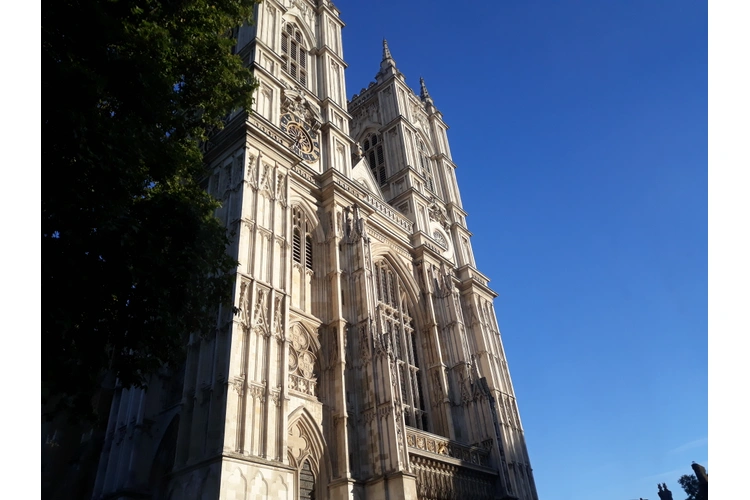
Walk into Westminster Abbey today, and you are not entering Edward the Confessor's church. Almost nothing visible above ground survives from the 11th century. What you see is largely the work of another king with grandiose architectural ambitions: Henry III.
Henry III reigned from 1216 to 1272—the longest reign of any medieval English king. He was cultured, pious, extravagant, and politically inept. His barons despised him and eventually went to war against him. But he was a great builder, and Westminster Abbey was his obsession.
In 1245, Henry began tearing down Edward the Confessor's church and replacing it with something more magnificent. He had visited France and seen the new Gothic cathedrals rising at Reims and Amiens—soaring structures of pointed arches and flying buttresses, flooded with light through vast stained-glass windows. He wanted the same for Westminster.
The result is the church you enter today: the highest Gothic nave in England (102 feet), a masterpiece of French-influenced Gothic design adapted to English taste. The geometry is French—the radiating chapels around the east end, the flying buttresses, the overall verticality. But details are English—the rich surface decoration, the use of Purbeck marble, the overall sense of elaborate ornament.
- Height of nave: 102 feet, the highest Gothic vault in England
- Cost: Perhaps £45,000, equivalent to many millions today
- Style: French Gothic geometry with English decorative details
- Materials: Expensive Purbeck marble from Dorset used throughout
Henry also created a new shrine for Edward the Confessor—an elaborate structure of gold and precious stones, raised high behind the altar so that pilgrims could walk beneath it. The shrine was the spiritual heart of the building, the reason for its existence. Kings came to be crowned here partly because Edward lay here. The Confessor's sanctity consecrated the monarchy.
The Coronation Chair
Near Edward's shrine stands the most famous piece of furniture in England: the Coronation Chair.
It was made in 1300-1301 for Edward I—Henry III's son—to contain a trophy of war: the Stone of Scone. This rough block of sandstone had been used for centuries in the coronation of Scottish kings. Edward I seized it in 1296 as a symbol of his conquest of Scotland, and he had a throne built around it so that English kings would literally sit upon Scottish sovereignty.
The chair is surprisingly modest—oak, originally gilded and painted (you can still see traces), about 700 years old and showing its age. It's been carved with graffiti by Westminster schoolboys, damaged by suffragettes (1914), and nearly destroyed by an IRA bomb (the bomb was discovered before it exploded).
Every monarch since Edward II has been crowned sitting in this chair—with two exceptions. When Elizabeth II was crowned in 1953, she sat in the same chair that Elizabeth I sat in, that Henry VIII sat in, that Richard III sat in. The wood beneath her was the same wood that had supported Edward II in 1308.
— Historical Continuity
The Tombs: A Who's Who of British History
Westminster Abbey is a cemetery. This seems an odd thing to say about a place so magnificent, but it's the essential truth. The Abbey exists, in large part, to house the dead.
The medieval English believed passionately in the power of prayer for the dead. The souls of the departed might linger in purgatory, suffering for sins not fully expiated in life. Prayers from the living could shorten their torment. So the wealthy endowed chapels and chantries—paying priests to say masses for their souls—and sought burial as close as possible to holy places and holy people.
- Henry III himself lies in Edward's original tomb
- Edward I is nearby, in a plain chest tomb
- Edward III has an elaborate tomb with weepers—small figures of his children—around the base
- Richard II commissioned a spectacular double tomb for himself and his queen, Anne of Bohemia
- Henry V, the hero of Agincourt, has a tomb that was once the most magnificent in the Abbey
- Henry VII built an astonishing new chapel at the east end of the Abbey with extraordinary fan vaulting
Elizabeth I has the most visited tomb in the Abbey. Her white marble effigy shows her in coronation robes, ruff and crown, sceptre and orb—the image of majesty. The Latin inscription calls her 'restorer of religion, extinguisher of war, founder of quiet, finally blessed in this monument.'
Yet just across the aisle lies Mary Queen of Scots—Elizabeth's cousin, her rival, her prisoner for nineteen years, and finally her victim. Elizabeth signed Mary's death warrant in 1587; Mary was beheaded at Fotheringay. Her son, James I, later moved her body to Westminster and gave her a tomb every bit as magnificent as Elizabeth's.
Poets' Corner
Turn to the south transept, and you enter a different kind of sacred space: Poets' Corner.
It began with Geoffrey Chaucer, who was buried here in 1400—not because he was a poet but because he had been a court official with apartments in the Abbey precincts. But by the 16th century, his grave had become a place of pilgrimage for admirers of the Canterbury Tales, and the idea of burying poets near poets took hold.
- Edmund Spenser, author of The Faerie Queene, was buried near Chaucer in 1599
- Ben Jonson followed in 1637, buried upright
- John Dryden in 1700
- Samuel Johnson in 1784
- Alfred, Lord Tennyson in 1892
- Robert Browning in 1889
Not everyone in Poets' Corner is actually buried here. Many are commemorated with monuments or plaques whilst their bodies lie elsewhere. Shakespeare has a monument (erected 1740) but is buried in Stratford. Milton has a monument but is buried in St Giles Cripplegate. Jane Austen wasn't commemorated until 1967—a small stone that acknowledges, belatedly, one of England's greatest novelists.
Walking through Poets' Corner is walking through English literature. Here is Handel's monument. Here is the memorial to the Brontë sisters. Here is Tennyson, bearded and lordly. Here is Chaucer's tomb, the origin and anchor of this corner where words are sacred.
Scientists, Statesmen, and Soldiers
Poets aren't the only commoners who earned burial in the Abbey. Scientists are here too.
Isaac Newton has one of the most elaborate monuments in the building—a baroque confection showing Newton reclining, surrounded by cherubs with scientific instruments, beneath a celestial globe. The inscription calls him 'an ornament to the human race.' He was buried here in 1727.
Charles Darwin lies near Newton, buried in the Abbey in 1882 despite having spent his life undermining the literal truth of the creation story. The decision to bury him here was controversial but carefully orchestrated by Darwin's friends and supporters.
Stephen Hawking's ashes were interred between Newton and Darwin in 2018—a physicist joining physicists, the great minds of their ages gathered in a few square feet of English church.
The Unknown Warrior
Just inside the west door, set into the floor so that every visitor must walk around it, lies the Tomb of the Unknown Warrior.
On 11 November 1920—the second anniversary of the Armistice—a body was brought to Westminster Abbey. It was one of six unidentified British soldiers exhumed from the battlefields of France; a blindfolded officer had selected one coffin from the six, and that body became the Unknown Warrior.
He was buried in soil brought from France, in a coffin made from oak timbers given by Hampton Court Palace. The grave was filled with 100 sandbags of earth from each of the main battlefields. The black Belgian marble slab bears an inscription beginning: 'BENEATH THIS STONE RESTS THE BODY OF A BRITISH WARRIOR UNKNOWN BY NAME OR RANK...'
For those with relatives lost in the Great War, whose bodies were never found or never identified, this tomb offers something irreplaceable: a place to grieve. One in six British soldiers killed in WWI has no known grave. Any one of them could be the Unknown Warrior. Every one of them is.
— Memorial Significance
When the future Queen Elizabeth married Prince Philip in 1947, she laid her wedding bouquet on this tomb. The tradition has continued: Kate Middleton did the same in 2011. The Unknown Warrior—anonymous, ordinary, one soldier among millions—has become the most honoured person in the Abbey.
The Building: An Architectural Tour
Westminster Abbey rewards careful looking. Here's what to notice:
- The Nave: 102 feet high, the highest Gothic vault in England. Look for the Purbeck marble columns
- The Crossing: Where the nave intersects with the transepts. The space feels enormous, open to the sky
- The Choir and Sanctuary: Where coronations take place. The cosmati pavement before the altar is one of the treasures of medieval art
- The Lady Chapel: Henry VII's Chapel with extraordinary fan vaulting—stone carved to look like frozen fabric
- The Cloisters: Remains of the medieval monastery. Around them are the Chapter House, the Pyx Chamber, and the museum
Visiting Westminster Abbey: A Practical Guide
Basic Information
- Address: 20 Deans Yard, Westminster, London SW1P 3PA
- Nearest Tube: Westminster (District, Circle, Jubilee lines) or St James's Park (District, Circle)
- Website: westminster-abbey.org
Opening Hours
- Monday-Friday: 9:30am-3:30pm (last entry)
- Saturday: 9:00am-3:00pm (last entry)
- Sunday: Open for worship only (no sightseeing tours)
Admission
- Standard admission (online): £27 adult, £12 child (6-17), free under 6
- Door price: Higher—book online to save
- Annual pass: Available for repeat visitors
- Free: Services are free to attend (no tours during services)
Tips for Your Visit
- Book online in advance to save money and guarantee entry
- Allow at least two hours—ideally three. There's an enormous amount to see
- Use the free multimedia guide included with admission
- Attend a service if you can. Evensong (5pm Monday-Friday, 3pm weekends) is particularly beautiful
- Visit the Queen's Diamond Jubilee Galleries in the triforium. The views alone are worth it
- Don't miss the Cloisters and Chapter House—included in admission but easy to overlook
- Go early or late to avoid the worst crowds
A Final Thought
Westminster Abbey is many things: a church, a mausoleum, a coronation theatre, a national monument, a tourist attraction, a working religious community. It's crowded and expensive and overwhelming. It's also irreplaceable.
This is what nations do: they create places where history accumulates, where the past becomes visible and tangible, where the dead speak to the living. Westminster Abbey is such a place, perhaps the most concentrated such place in Britain. Every stone has a story. Every monument marks a life. Every visitor adds another layer to the Abbey's endless accumulation of memory.
— Reflections on National Memory