When London Vanished: The Mystery of the 200 Lost Years
Augusta at Its Height
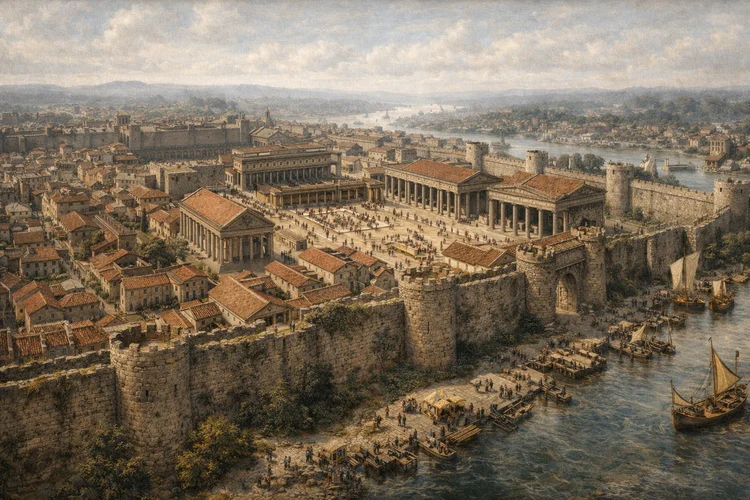
To understand the scale of what was lost, we must first picture Roman London in its glory days. By the late 4th century AD, the city known as Augusta (its honorary title meaning 'the august' or 'venerable one') was a marvel of Roman engineering and urban planning.
The city was protected by a formidable wall, over three miles long, built of rubble and mortar faced with stone. Roman brick courses—distinctive double layers about two feet apart—ran through the structure. The wall stood 20 feet high, with towers and bastions rising to 50 feet. Seven double gates pierced this defensive circuit: Aldgate, Bishopsgate, Cripplegate, Aldersgate, Newgate, Ludgate, and the Bridge Gate.
Within these walls lived a cosmopolitan population. The wealthy lived in Roman villas—elegant single-storey houses built around colonnaded courtyards, with heated floors, tessellated pavements, painted walls, and fine glass windows. The middle class inhabited comfortable homes along the better streets. The poor crowded into tenements near the riverside.
The heart of the city was a massive complex that would have rivalled anything outside Rome itself. Based on what archaeologists have discovered at similar sites like Silchester, London's forum and basilica would have been a vast public space surrounded by shops and administrative buildings, with a great hall more spacious than Westminster Hall for the administration of justice.
The Slow Collapse
The end did not come suddenly. It crept up slowly, inexorably, over decades. The signs of trouble began long before the Romans officially withdrew from Britain in 410 AD.
As early as 368 AD, Picts and Scots were pouring down from the north, sometimes penetrating as far as the Middlesex Forest near London. The Romans had to send military expeditions to drive them back. Saxon pirates were harrying the eastern and southern coasts, even establishing permanent settlements. The officer called the 'Count of the Saxon Shore'—responsible for defending the coastline—saw his fleets destroyed and was killed in battle.
For a city that lived entirely by trade, this was catastrophic. London produced nothing itself—no food, no raw materials. Everything had to be imported along four great Roman roads or up the Thames by barge. The city depended on a constant flow of supplies from the countryside.
- First, the East Saxons settled in Essex, stopping supplies from the eastern counties
- Then, the Jutes landed on the Isle of Thanet and spread across Kent, blocking the Thames and the road from Dover
- More Saxons pressed down from the north, cutting off Watling Street
- Finally, enemies reached the middle Thames, and no more barges came upriver with provisions
A City Dying of Starvation
The people of Augusta faced a choice no city dwellers should have to make: flee or starve. London could not feed itself. The marshes surrounding the city on three sides produced no crops. The forest to the north was wild and dangerous. Without supplies from the agricultural heartland of Britain, the city was doomed.
Consider what this meant for the residents. These were not hardy warriors accustomed to living off the land. They were merchants, craftsmen, clerks, scribes, artists, physicians, lawyers, actors—people who had lived comfortable, even luxurious, lives. For nearly four hundred years, since the conquest by Claudius in 43 AD, Londoners had lived at peace, protected by Roman legions, free to grow wealthy and soft.
Many were not even Britons. London was a cosmopolitan trading port, full of merchants from Gaul, Germany, Spain, and elsewhere. The city also held a large slave population who worked the docks, the warehouses, and the households of the rich.
In 407 AD, a usurper named Constantine had raised a revolt and taken many of Britain's young men across to Gaul to fight in his doomed bid for power. This drained the province of its best fighting material. Who was left to defend Augusta? Old men, foreigners, slaves, and merchants who had never held a sword.
— Historical Analysis
The Great Exodus
Picture the scene as it must have unfolded, perhaps in the early years of the 5th century. The realisation has finally come: no more supplies will reach the city. The roads are closed. The river is blocked. The great warehouses are empty. Famine is no longer a threat but a reality.
Families began to leave, not all at once, but in small groups for greater safety. They went out through the gates—probably Newgate, leading to Watling Street and the west where Britons still held their ground. But they could not follow the open road, which was watched by enemies. Instead, they turned aside into the great Middlesex Forest.
They carried what they could—weapons, a little food, perhaps a child too young to walk. They left behind everything else. The marble baths, the silk hangings, the tessellated pavements, the pictures and statues, the couches and tables—all the luxuries of Roman life—became meaningless when measured against survival.
They left the City by the gate; they did not journey along the road, but for safety turned aside into the great forest, and so marching across moors and marshes, past burnt homesteads, and ruined villages, and farm buildings thrown down, those of them who did not perish by the way under the enemies' sword or by malarious fever, or by starvation, reached the Severn.
— Walter Besant, 19th-century historian
The Remnant
Not everyone left. There were always those too old, too ill, too poor, or too stubborn to flee. These people—'the baser sort, protected by their wretchedness and poverty'—remained in the ruins.
What was their life like in the hollow shell of Augusta? They shut and barred the gates. They blocked the bridge. They took what they wanted from the abandoned villas—warm cloaks, woollen garments, coverlets. But they lived in their old hovels near the riverbank, not in the grand houses they now occupied as squatters.
The works of art meant nothing to them. The pictures, statues, and mosaic floors were left to decay or destroyed in wanton vandalism. The roofs of the villas and churches fell in. The gardens grew wild. The walls began to crumble.
These survivors fished in the Thames for food. They hunted over the marshes where Westminster and Lambeth would later rise. The years passed—ten, twenty, fifty, a hundred. The thin veneer of Roman civilisation was lost, along with whatever arts they had learnt. Even their Christianity faded, leaving only a nameless terror of the unknown.
Why Didn't the Saxons Take It?
This question puzzles many people. The Saxons had conquered the land all around London. The East Saxons held Essex. The Jutes controlled Kent and Surrey. The South Saxons ruled Sussex. The West Saxons dominated Wessex. London was surrounded on all sides by the conquerors.
Yet they didn't take the city because there was nothing to take. London was silent. No ships came and went to remind the Saxons of its existence. It lay amid its marshes and moors, the old roads choked with vegetation, forgotten. The Saxons had already done to other cities what they would have done to London—Canterbury, Silchester, Porchester, Colchester, Anderida (Pevensey)—all were taken, their inhabitants massacred, the walls left standing empty.
But London was different. The people had left before the Saxons arrived. The slow strangulation of the city's supply lines had accomplished what an army might have done with blood and fire. The city died not with a bang but with a whimper—of hunger, of disease, of despair.
The Rediscovery
How long did this oblivion last? No one knows when it began or when it ended. But somewhere around the late 6th century, an extraordinary scene may have unfolded.
Picture a hunting party of East Saxons pursuing game through the great forest, following their prey across the marshes of the River Lea. Suddenly, before them, they see something impossible: the grey walls of a great city they have never heard of.
They advance cautiously along a firm road (the Vicinal Way), now grass-covered. They expect to see defenders on the walls. None appear. The gates are closed, but the timbers are rotten and fall down at a touch. The men break through.
They find themselves in the streets of a ruined city. They run about, shouting. No one appears. The city is utterly deserted. The few surviving inhabitants, seeing armed men, may have hidden or fled. Or perhaps even they were gone by then, the last remnant having finally died out or wandered away.
The Saxon hunters went away and told what they had found. But Augusta had perished. When the city appears again in history, it is under its more ancient name—it is London again, no longer the Roman 'Augusta'.
What the Ground Tells Us
How do we know this story? Not from written records—there are almost none for this period. Instead, we read it from the ground itself, from the testimony that cannot lie.
- The lie of the ground tells us that London sat among marshes that could only be crossed by the Roman roads
- The city could not feed itself without constant imports from the countryside
- The absence of traces of 5th and 6th-century occupation tells us the city was abandoned
- The lack of destruction layers tells us there was no siege, no massacre, no sudden conquest
- Archaeological evidence shows dramatic decline in imported pottery and other goods from the late 4th century onwards
Lessons from the Lost Years
What can we learn from London's disappearance? Several sobering lessons emerge from this episode:
- The Fragility of Urban Civilisation: Cities are magnificent achievements, but they are also vulnerable. London could not exist without constant supplies from the countryside
- The Importance of Security: The Roman withdrawal and the collapse of organised defence made trade impossible and supply lines vulnerable
- The Speed of Collapse: Within a human lifetime, London went from a thriving Roman city to a ghost town
- The Loss of Knowledge: When a civilisation falls, knowledge can vanish almost completely. The Romano-British could build heated villas and create mosaic floors. Two centuries later, the Saxons who found the ruins didn't even know who had built them
The Pattern Repeats
Remarkably, London experienced this cycle twice. The city vanished after the Romans left around 410 AD. It was reborn as a Saxon city around 610 AD. Then, around 850 AD, the Danes took London and held it as their headquarters. When they were expelled, the city was once again in ruins.
King Alfred found London in 884 AD much as the East Saxons had found it three centuries before—a city of ruins with the wall in decay and the churches destroyed. Alfred rebuilt London, creating what one historian called effectively a new foundation.
Visiting Roman London Today
For those who want to connect with this lost world, several sites in London offer glimpses of what was lost during those mysterious two centuries:
The Museum of London houses the finest collection of Roman London artefacts, including items that span the period from thriving Augusta to its abandonment. The museum's displays include sections of the Roman wall, mosaics from villa floors, and everyday objects that bring the lost city to life.
The Roman Wall still survives in fragments. The most impressive sections can be seen near the Museum of London itself, in the churchyard of St Giles Cripplegate, and at Tower Hill. Standing before these walls, you can touch the same stones that the last Romans saw as they abandoned their city.
The Amphitheatre beneath the Guildhall Art Gallery gives a vivid sense of Roman public entertainment. Discovered only in 1988, it has been partially reconstructed, allowing visitors to stand where Roman Londoners once watched gladiatorial contests.
The Temple of Mithras (now relocated near Bloomberg's headquarters) was a small but beautifully preserved example of Roman religious practice. Its discovery in 1954 caused a sensation, with thousands queueing to see it before construction resumed.
The London Wall Walk follows the circuit of the Roman and medieval walls, with information panels explaining what you're seeing. Walking this route gives a powerful sense of the area that was once enclosed and protected—and then abandoned.
The Mystery Endures
Despite all our archaeological advances, many questions about the lost years remain unanswered. Did everyone really leave, or did a larger population somehow persist in ways that left no archaeological trace? How long did the final remnant survive in the ruins? What did those last Londoners think as they looked at the decaying grandeur around them?
Somewhere in the silt of the Thames, in the foundations of modern buildings, in the layers of earth beneath London's streets, the evidence of those lost years waits. Perhaps future archaeologists will uncover new clues. Perhaps the mystery will deepen.
— Archaeological Perspective
The story of how London vanished—and how it returned—remains one of the most compelling chapters in the long history of this ancient city.